Finding screen-time activities that are entertaining, educational, and appropriate for young children can be challenging. The good news is that children do not need complicated apps or expensive subscriptions to practice important early-learning skills.
Free educational games for kids ages 3–8 can turn a few minutes of play into an opportunity to explore letters, numbers, memory, creativity, logic, and problem-solving. The best games provide simple instructions, colorful environments, age-appropriate challenges, and enough variety to keep children interested.
At Free Puzzle Kids, children can play educational games online directly in their browser. There is no software to download and no account required to begin playing. Families can simply choose a game and start exploring.
Choosing Educational Games for Every Age from 3 to 8
The best free learning games are not necessarily the most complicated. For children between the ages of three and eight, a good educational game should be easy to understand while giving the child a meaningful challenge.
Some of the most helpful types of learning games include:
- Jigsaw and picture puzzles
- Memory-matching games
- Alphabet and letter-recognition activities
- Number and early-math games
- Word searches
- Coloring and creative games
- Animal sound activities
- Logic and visual-thinking challenges
- Mazes and problem-solving games
Each category supports a different part of a child’s development.
Puzzle games can encourage patience and visual reasoning. Memory games ask children to concentrate and remember the location of pictures. Letter and word games introduce early literacy skills, while number games provide practice with counting and recognizing quantities.
Creative games are valuable too. Coloring, drawing, and imaginative activities allow children to make choices, experiment with colors, and express their own ideas.
The best choice depends on the child’s age, interests, and current abilities. A three-year-old may enjoy matching large colorful pictures, while a seven- or eight-year-old may prefer a word search, maze, or more challenging puzzle.
What Are Some Free Educational Games Children Can Play Online?
Children can play many different educational games online without installing an app. Browser-based activities are especially convenient because they can work on computers, tablets, and many smartphones.
Here are several useful categories to explore.
Online Puzzle Games
Puzzles encourage children to look carefully at shapes, colors, positions, and visual details. They must determine where each piece belongs and continue trying until the picture is complete.
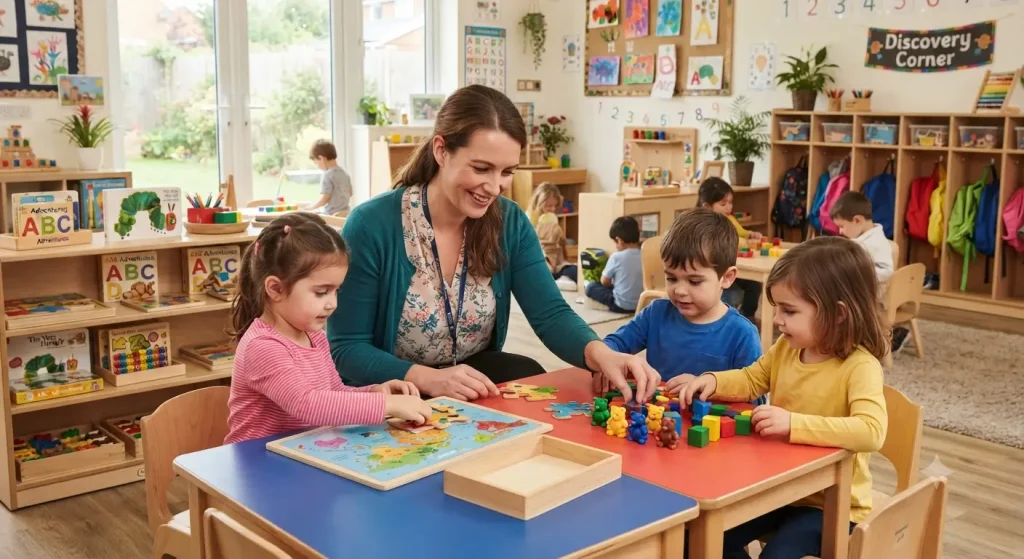
A puzzle made from a familiar or favorite image can be particularly engaging. Children can enjoy the picture while practicing spatial awareness, concentration, and persistence.
Try the Cartoon Photo Puzzle and turn playtime into a colorful problem-solving activity.
Memory-Matching Games
Memory games usually begin with a collection of face-down cards. Children reveal two cards at a time and try to find matching pictures.
Although the rules are simple, children must pay attention and remember what they previously saw. This makes matching games helpful for visual memory, concentration, turn-taking, and attention to detail.
You can also explore these free memory games for kids ages 3–5.
Alphabet and Letter Games
Alphabet games can help preschool and kindergarten children become familiar with uppercase letters, lowercase letters, beginning sounds, and simple words.
Young learners benefit from activities that connect letters with recognizable objects or sounds. Short, playful sessions can make early reading practice feel less intimidating.
Families looking for literacy activities can begin with these free letter-recognition games for preschoolers.
Number and Early-Math Games
Children encounter numbers everywhere: on clocks, doors, books, calendars, toys, and signs. Number games help them recognize symbols and connect those symbols with quantities.
Depending on the child’s age, an early-math game may include:
- Recognizing numbers
- Counting objects
- Comparing groups
- Identifying patterns
- Practicing simple addition
- Matching numbers with quantities
The goal is not to rush children into advanced mathematics. It is to help numbers become familiar and understandable through play.
Coloring and Creative Games
Educational play does not have to focus exclusively on letters and numbers. Creative games give children opportunities to select colors, experiment with combinations, and create something of their own.
Digital coloring activities can be useful during quiet time, indoor play, or transitions between more structured learning activities.
Word Search Games
Word searches are generally best for children who already recognize letters and are beginning to read simple words. They encourage children to scan carefully, follow letter patterns, and stay focused on a goal.
Younger learners may begin with short words presented in clear horizontal or vertical arrangements. Older children can attempt larger puzzles with words placed in multiple directions.
Cognitive and Logic Games
Logic games invite children to observe, compare, predict, and solve problems. These activities might involve matching objects, identifying differences, completing patterns, navigating mazes, or deciding which item does not belong.
Explore more educational cognitive games for kids designed to make thinking practice enjoyable.
What Are Some Free Educational Games for 3-Year-Olds?
Educational games for three-year-olds should be simple, visual, and forgiving. At this age, children are still learning how to follow instructions, control a mouse or touchscreen, and remain focused on one activity.
Good choices include:
- Matching two identical pictures
- Sorting objects by color or shape
- Completing puzzles with a small number of pieces
- Listening to and identifying animal sounds
- Coloring large pictures
- Counting small groups of objects
- Recognizing common letters
- Finding basic shapes
- Matching objects with their shadows
A three-year-old should be able to understand the main goal quickly. Avoid activities with long written instructions, crowded screens, or penalties for incorrect answers.
Parents and caregivers can make the experience more educational by talking about what appears on the screen. Simple questions such as “What color is that?”, “Which piece comes next?” or “Can you find another animal?” encourage children to describe their thinking.
What Is the Best Game for a 3-Year-Old?
There is no single best game for every three-year-old. The best choice is usually an activity that matches the child’s interests and provides a small, achievable challenge.
For many three-year-olds, a simple picture puzzle or memory-matching activity is an excellent starting point. These games use familiar images, require minimal reading, and allow children to learn through observation.
A suitable game for this age should have:
- Large, easy-to-select objects
- Bright and recognizable pictures
- Simple instructions
- Short rounds
- Encouraging feedback
- No complicated menus
- No pressure to finish quickly
If a child becomes frustrated, select an easier activity or play together. Educational games should encourage curiosity, not make a young learner feel tested.
How Can You Entertain a 3-Year-Old Indoors at Home?
Online games can be part of a balanced indoor routine, especially when combined with creative and physical activities.
For example, families can create a simple play sequence:
- Complete a short online puzzle.
- Name the objects or animals shown in the picture.
- Draw or color a related picture.
- Count similar objects around the room.
- Act out an animal movement or sound.
- Read a short story connected to the same theme.
A child who plays an animal-sound game might then imitate the animal, draw it, or find it in a picture book. A number game can lead to counting toys, blocks, or snacks.
These connections help children understand that learning is not limited to a screen. A short online activity can introduce an idea that continues through conversation, movement, art, and imaginative play.
What Is the Best Free Online Game for Kids?
The best free online game is one that is appropriate for the child, easy to access, enjoyable to replay, and connected to a useful skill.
Parents should consider several questions:
- Is the activity suitable for the child’s age?
- Can the child understand what to do?
- Does the game encourage active participation?
- Is it building a useful skill?
- Does it work without a complicated installation?
- Can the child play without creating an account?
- Is the experience comfortable on the family’s device?
A colorful game is not automatically educational. The child should be observing, remembering, deciding, creating, counting, reading, or solving something during play.
That does not mean every minute must feel like a lesson. Play and learning can happen together naturally.
Which Educational App Is Totally Free?
Many parents use the word “app” when referring to any interactive activity on a phone or tablet. However, there is an important difference between a downloadable mobile app and a browser-based game.
Free Puzzle Kids provides browser-based educational games rather than requiring families to install a traditional app. Children can open the website and play available free games online without downloading software or creating a child account.
This can be convenient for families who:
- Do not want to install another application
- Have limited storage space
- Use different devices
- Prefer not to create an account
- Want to begin playing immediately
Visit Free Puzzle Kids to explore the currently available games and activities.
What Is the Best Free Educational App for Kids?
The best educational option depends on what the child needs to practice. Instead of selecting an activity based only on popularity, parents can match the game with a specific learning goal.
| Learning goal | Recommended type of game |
|---|---|
| Concentration | Memory matching |
| Problem-solving | Puzzles and mazes |
| Letter recognition | Alphabet games |
| Early reading | Word and letter games |
| Counting | Number games |
| Creativity | Coloring activities |
| Listening | Animal sound games |
| Visual reasoning | Matching and logic games |
Variety is often more helpful than repeatedly using only one type of activity. A child might complete a puzzle one day, practice letters the next day, and enjoy a creative coloring game afterward.
This gives children multiple ways to learn and helps prevent the experience from becoming repetitive.
How to Choose Educational Games for Children Ages 3–8
Children develop rapidly between ages three and eight. A game that works well for a preschooler may be too easy for a second-grade student.
Ages 3–4
Choose large images, short activities, basic matching, colors, shapes, sounds, and simple puzzles.
Ages 5–6
Introduce letter recognition, beginning sounds, number practice, patterns, memory challenges, and puzzles with more pieces.
Ages 7–8
Look for word searches, logic games, reading activities, math practice, mazes, and more detailed puzzles.
Age labels are helpful, but every child develops differently. Observe whether the game feels too easy, comfortably challenging, or frustrating. The ideal activity allows the child to succeed while still requiring attention and effort.
Benefits of Free Educational Games for Kids Ages 3–8
Well-designed educational games can support several abilities at the same time.
Concentration
Children practice staying with an activity until they reach a goal.
Memory
Matching and recall activities require children to remember images, locations, sounds, or patterns.
Problem-Solving
Puzzles and logic challenges teach children to try different approaches when the first attempt does not work.
Early Literacy
Letter, sound, and word games help children become more comfortable with the building blocks of reading.
Early Math
Counting, comparison, patterns, and number-recognition activities help make mathematical ideas more familiar.
Creativity
Coloring and open-ended activities encourage experimentation and personal expression.
Persistence
Games give children a safe opportunity to make mistakes, try again, and experience the satisfaction of completing a challenge.
Tips for Making Online Learning More Valuable
Parents and teachers do not need to direct every moment of play, but a little participation can make an activity more meaningful.
Try these simple ideas:
- Let the child choose between two appropriate games.
- Ask the child to explain what they are doing.
- Connect the game with objects found at home or in the classroom.
- Celebrate effort instead of only correct answers.
- Change activities when the child loses interest.
- Choose a difficulty level that provides a manageable challenge.
- Balance online play with reading, drawing, movement, and conversation.
Short, focused sessions are often more effective than expecting a young child to remain on one activity for a long time.
Play Free Educational Games at Free Puzzle Kids
Free Puzzle Kids offers puzzles, memory activities, letters, numbers, coloring, word games, and other playful learning experiences for young children.
The games are designed to be easy to access from a modern browser, allowing families to begin without downloading an app or creating a child account.
Choose an activity, invite your child to explore, and let learning become part of the adventure.
Play free educational games for kids and discover a growing collection created for curious young learners.
Frequently Asked Questions
What are some of the best free learning games for kids?
Puzzles, memory matching, alphabet games, number activities, word searches, coloring games, and logic challenges are among the best free learning games for young children. The right choice depends on the child’s age and learning goals.
What are some free educational games for 3-year-olds?
Good educational games for three-year-olds include simple picture puzzles, color and shape matching, animal sounds, basic counting, large-image coloring activities, and memory games with only a few pairs.
Which educational app is totally free?
Free Puzzle Kids provides free browser-based educational games that can be played online without installing a traditional app. Available games can be opened directly from the website without creating a child account.
What are some free educational games I can play online?
Children can play online puzzles, memory-matching games, alphabet activities, number games, word searches, coloring games, animal-sound activities, and logic challenges.
What is the best free online game for kids?
The best game is one that matches the child’s age, interests, and abilities. For younger children, picture puzzles and matching games are excellent starting points. Older children may enjoy word searches, mazes, number games, and logic challenges.
How can I entertain a 3-year-old indoors at home?
Combine a short educational game with drawing, counting household objects, reading a related story, singing, building with blocks, or acting out animals and characters from the activity.
Do children need to download anything to play?
No download is required for the browser-based games available through Free Puzzle Kids. Children can open a compatible game and play directly online.
Are these educational games suitable for tablets?
Browser-based games can generally be played on modern computers, tablets, and smartphones. The exact experience may vary depending on the game, browser, screen size, and device.
Choose and play with confidence
Visit our collection of free online educational games for kids, and review the parent and teacher checklist for choosing quality educational games.