Why Educational Games Matter for Young Learners
Finding high-quality free games for kids should not be difficult. Children love to play, explore, solve problems, and discover new things—and the right online games can turn those natural interests into meaningful learning experiences.
At Free Puzzle Kids, children can enjoy fun educational games designed to encourage creativity, memory, concentration, early literacy, problem-solving, and independent learning. Our activities are created especially for young learners, parents, and teachers who want screen time to feel playful and purposeful.
Whether your child enjoys puzzles, coloring, matching pictures, learning letters, recognizing sounds, or exploring new challenges, there is something fun waiting to be played. Best of all, our free online games are easy to access directly from a browser, with no complicated setup required.
Why Are Educational Games Good for Kids?
Play is one of the most natural ways for children to learn. When children play an educational game, they are not simply looking at a screen. They are making decisions, testing ideas, remembering patterns, coordinating movements, and learning from their mistakes.
Well-designed educational games can help children develop important abilities, including:
- Memory and concentration
- Hand-eye coordination
- Logical thinking and problem-solving
- Letter, number, color, and shape recognition
- Creativity and imagination
- Patience and persistence
- Confidence when completing a challenge
The most effective learning games do not make children feel as though they are completing a lesson. Instead, they make practice feel like an enjoyable adventure. A child may repeat the same activity several times because it is entertaining, and that repetition can strengthen developing skills.
Free Online Games for Kids at Free Puzzle Kids
Every child has different interests and learns in a different way. That is why Free Puzzle Kids offers several types of activities rather than a single style of game. Children can choose a quiet puzzle, a creative coloring activity, a memory challenge, or a lively learning adventure.
Here are some of the experiences children can explore.
Puzzle Games
Puzzles encourage children to look closely, compare details, recognize patterns, and think about how individual pieces fit together. They are a simple but powerful way to exercise visual-spatial reasoning and problem-solving skills.
Our puzzle activities give young players an opportunity to work at their own pace. Finishing a puzzle can also provide a satisfying sense of accomplishment, especially when a child solves it independently.
Memory Matching Games
Memory games ask children to remember the location of pictures and find matching pairs. Although the idea is easy to understand, every round provides valuable practice in attention, visual memory, and concentration.
These games are useful for short learning breaks at home or in the classroom. Children can try to improve their performance while enjoying colorful, friendly images.
Coloring Games
Digital coloring gives children space to experiment with colors and express their creativity. They can make unusual combinations, change their choices, and create a picture that feels completely their own.
Coloring activities may also support color recognition, careful movement, and creative decision-making. They are particularly helpful when children need a calm activity after a busy lesson or an energetic part of the day.
Letter and Word Games
Early literacy grows through regular exposure to letters, sounds, and words. Letter and word games can make this practice more inviting by giving children a clear goal and immediate interaction.
Young learners can become more familiar with the alphabet, notice letter patterns, and build confidence with foundational language concepts. These activities can complement reading practice with a parent, caregiver, or teacher.
Animal Sound Games
Children are naturally curious about animals and the sounds they make. Animal sound activities combine listening, recognition, and visual clues to create an engaging learning experience.
They can encourage children to connect an animal with its sound while practicing careful listening. Parents and teachers can extend the activity by asking where each animal lives, what it eats, or how it moves.
Creative Photo Puzzles
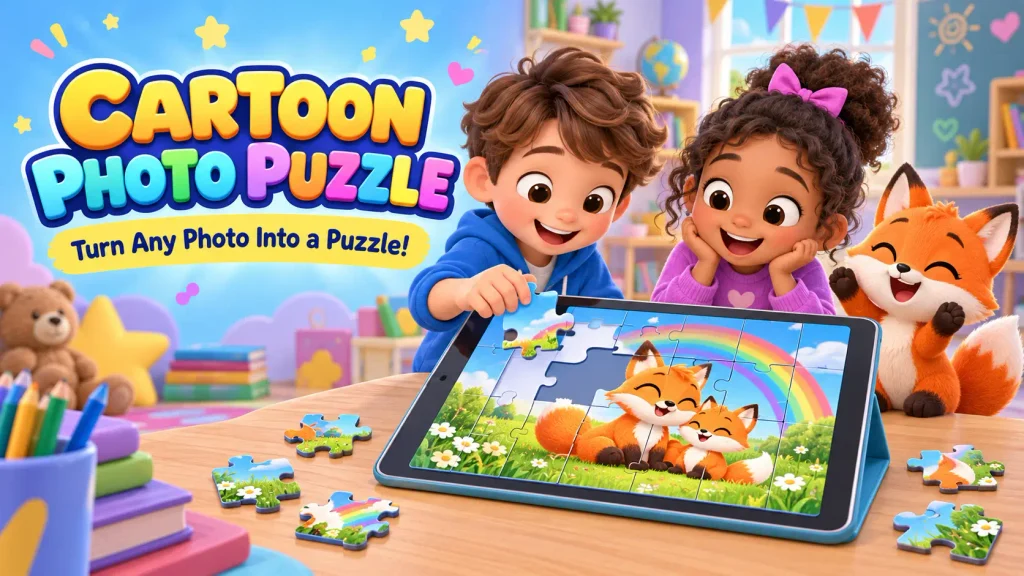
Some children are especially motivated when an activity includes a familiar image. A creative photo puzzle allows a parent or caregiver to choose an appropriate picture and transform it into a personalized puzzle experience.
This can make puzzle play feel exciting and unique. Families should always supervise young children and choose images that are safe and suitable for their age.
Learning Through Play at Home
Parents do not need to turn every game into a formal lesson. A few simple questions can encourage children to think and talk about what they are doing:
- What do you notice in this picture?
- Which piece do you think belongs here?
- Can you remember where you saw the matching card?
- What color would you like to use next?
- What strategy could you try?
- Can you tell me how you solved it?
These conversations help children describe their thinking and can introduce useful vocabulary. Just as importantly, they show children that effort and experimentation matter.
A short period of focused play is often more valuable than a long session that leaves a child tired or frustrated. Parents can choose an activity appropriate for the child’s age, remain nearby when needed, and allow the child to stop or switch games when attention begins to fade.
Free Games for Kids in the Classroom
Teachers can use online games as flexible classroom resources. A game may be included in a learning center, used during indoor recess, offered as an early-finisher activity, or played during a short transition between lessons.
Educational games can also provide an alternative way to practice a skill. A child who feels hesitant during a worksheet activity may feel more comfortable exploring the same type of concept through play.
Possible classroom uses include:
- A memory game during a concentration station
- A puzzle as an early-finisher activity
- A coloring game during a calm classroom break
- A letter activity for early literacy practice
- An animal sound game during a science or listening lesson
- A supervised game displayed on an interactive whiteboard
Teachers can invite children to play individually, work with a partner, or solve a challenge together as a group. The goal is not simply to keep students occupied, but to select an activity that fits the classroom moment and the learners’ needs.
Choosing Age-Appropriate Online Games
Not every game is right for every child. When selecting free games for kids, parents and educators should consider the child’s age, interests, reading level, coordination, and ability to follow instructions.
A suitable game should offer a manageable challenge. If it is too easy, the child may lose interest. If it is too difficult, the child may become frustrated. The ideal activity encourages the player to think while still providing a realistic path to success.
Adults should also look for:
- Clear and simple instructions
- Large, easy-to-use controls
- Child-friendly images and language
- A calm design without unnecessary distractions
- Activities that reward effort and progress
- Content appropriate for young learners
Supervision remains important, particularly for younger children. Playing together for the first few minutes can help an adult confirm that the activity is appropriate and show the child how the controls work.
Making Screen Time More Meaningful
Screen time is not all the same. Watching videos passively and interacting with a problem-solving game are different experiences. Educational games can invite children to make choices, recall information, create something, or respond to a challenge.
However, online play should be part of a balanced day. Children also need physical movement, conversation, imaginative play, books, art, outdoor experiences, and rest. A digital game works best as one useful activity among many.
Adults can make game time more meaningful by connecting it to an offline activity. After completing an animal game, a child could draw a favorite animal. After playing a letter game, the child could look for that letter in a book. After finishing a puzzle, the family could build a physical puzzle together.
These simple connections help move learning beyond the screen.
Why Families and Teachers Choose Free Puzzle Kids
Free Puzzle Kids brings playful learning activities together in one convenient place. The website is designed for families and educators looking for approachable activities for young children.
Our goal is simple: help children learn, play, and grow through enjoyable experiences. There is no need to make learning feel heavy or stressful. A colorful puzzle, a matching challenge, or a creative activity can inspire curiosity and give children another opportunity to practice important skills.
Along with online games, Free Puzzle Kids also offers educational resources and printable worksheets for parents and teachers. This makes it easier to combine digital learning with hands-on practice.
Start Playing Free Games for Kids Today
Children learn best when they feel curious, comfortable, and involved. The right game can capture their attention while encouraging them to observe, remember, experiment, and solve problems.
Explore the collection of free games for kids at Free Puzzle Kids and choose an activity that matches your child’s interests. Try a puzzle, test your memory, create a colorful picture, practice letters, or discover animal sounds.
There is always something new to learn—and learning can begin with play.
[Explore Free Educational Games for Kids]
Frequently Asked Questions
Are the games on Free Puzzle Kids free?
Yes. Children can play the free games available on Free Puzzle Kids directly online. The website also offers separate educational resources and premium tools for parents and teachers.
What ages are these games designed for?
Many activities are designed for young children, particularly preschool, kindergarten, first-grade, and second-grade learners. Parents and teachers should select games based on each child’s individual ability and interests.
Do children need to download an app?
No download is needed for the browser-based games. Children can open a compatible web browser and begin playing online.
Can teachers use these games in the classroom?
Yes. Teachers can use them for learning centers, early-finisher activities, indoor breaks, supervised technology time, or additional skill practice.
Can educational games replace regular lessons?
Educational games are best used as a complement to teaching, reading, conversation, creative play, physical activity, and hands-on learning. They provide another enjoyable way for children to practice useful skills.
How can parents make online gaming safer?
Parents can remain nearby, choose age-appropriate activities, establish reasonable time limits, and talk with children about what they are playing. Young children should use the internet with adult guidance.
Turn these benefits into practical play
Start with our free online educational games for kids. Parents and teachers can also use our quality checklist for educational games and our educational games by age guide.