Free online educational games for kids ages 3–8 — puzzles, letters, numbers, memory and more. Everything plays right in your browser: click and learn, nothing to install.
Free online educational games for kids are browser-based learning activities — puzzles, word searches, letter and number games, memory and coloring — that build real skills through play, cost nothing, and need no download or sign-up. The best one isn’t the flashiest; it’s the one that fits your child’s age and the skill you want to practice.
Start here
Find the right free game in 2 taps
Pick your child’s age and what they’d like to practice — we’ll point you to a free game to play right now.
🎯 Game finder
There’s no universal “#1 game.” Fit beats popularity — so let’s match one to your child.
1 · Age
2 · What to practice
Pick an age and a skill above to get a recommendation.
Browse by type
Kinds of free educational games
Different games build different skills. Every category below is free to play in the browser.
🧩
PuzzlesSpatial reasoning and persistence — fit the pieces, complete the picture.Play puzzles →
🔎
Word searchEarly reading and spelling — spot hidden words and grow vocabulary.Play Word Search Kids →
🔤
Letters & phonicsConnect letters to their sounds — the foundation of reading.Play letter games →
🔢
NumbersCounting, comparison and quantity sense for early math.Play number games →
🌀
Word mazePlanning and flexible thinking — find the path, revise the plan.Play the Word Maze →
🎨
Creative & exploreColoring, storytelling and open-ended play for expression.Explore all games →
Play instantly
Play free online — no download needed
One of the most common questions parents ask is whether they have to download anything. With browser games, you don’t.
✓ Browser games (what we do)
Click a link and play — nothing to install
Work on computers, tablets and Chromebooks
Update automatically, no storage used
Fewer permissions to worry about
Downloadable apps
Install from an app store first
Often tied to one device or OS
Need updates and device storage
Can work offline once installed
Downloadable and offline games have their place — but if you want kids learning in the next thirty seconds, a browser game like Free Puzzle Kids is the fastest, lowest-friction path. No app, no waiting.
Free & safe
Are they really free — and safe?
“Free” and “safe” are the two things parents check most. Here’s the short version:
💛
Actually freeThe core games play with no payment. Just confirm the “core” is the whole game, not a locked demo.
🔒
Little dataA puzzle doesn’t need a full name, location, camera or mic. Less collected is safer.
🚪
No forced sign-upGames you can start without an account reduce both friction and risk.
The safest sites publish a clear privacy policy, keep ads and purchases away from the child’s controls, and avoid open chat with strangers. Free Puzzle Kids sets out its approach in a dedicated Privacy Policy — and it’s always good practice to play the first round yourself before handing over the device.
People also ask
Frequently asked questions
Best free online games for kids
What is the best free online game for kids?+
There’s no single best — the best free online game is the one that matches your child’s age and the skill you want to build: a puzzle for spatial reasoning, a word search for early reading, or a number game for counting. On Free Puzzle Kids they’re all free and play in the browser.
What is the safest online game for kids?+
The safest online games need no sign-up, collect little or no personal data, keep ads and purchases away from the child, and publish a clear privacy policy. Browser games you can start without an account are usually the safest choice.
What free game websites are safe?+
A safe game website identifies who runs it, publishes understandable privacy information, minimizes data requests, avoids open chat with strangers, separates ads and purchases from gameplay, and lets kids play without registration. Always test a site yourself first.
What is the best website to play free games online without downloading?+
Any browser-based site lets you play free games with no download — you click a link and start instantly. Free Puzzle Kids is one example built for ages 3–8, with puzzles, letters, numbers and word games that need no install and no account.
What are the top free online games for kids?+
Popular free picks include word searches, word mazes, jigsaw puzzles, letter games and number games. Rather than chasing a “top 5” or “top 10,” start with the child’s age and interest — fit keeps kids engaged far longer than a ranking does.
Best free learning apps for kids
Which learning app is completely free?+
Several are. Khan Academy and Khan Academy Kids are free nonprofits, and browser sites like Free Puzzle Kids are free to play with no sign-up. Which is “best” depends on your child’s age and the subject you want to practice.
Is Khan Academy 100% free?+
Yes. Khan Academy is a nonprofit and its core learning content is free, with no required subscription. It leans toward structured lessons, while game-based sites suit younger children who learn best through play.
Is Khan Academy Kids really free?+
Yes. Khan Academy Kids (designed for roughly ages 2–8) is free, with no ads or subscriptions. For quick browser play with no install, Free Puzzle Kids is another free option for the same age range.
What are some free educational games I can play online?+
Free online options include puzzles, word searches, letter and phonics games, counting and number games, memory matching, and coloring — all playable in the browser at Free Puzzle Kids, no download required.
What are the best free learning websites for kids?+
Look for sites with a clear learning goal per activity, a real privacy policy, no forced registration, and age-appropriate challenge. A browser-based site like Free Puzzle Kids fits kids 3–8 who learn through play.
Fun free online games
What is the most fun free online game?+
The most fun game is the one that’s “just right” — challenging but achievable. Word searches, mazes and puzzles keep kids engaged without tipping into frustration, which is exactly where learning and fun overlap.
What games are completely free?+
A completely free game runs its full core activity with no payment (it may still be ad-supported). The games on Free Puzzle Kids are free to play — check that ads and links are clearly separated from the child’s controls.
Where can I play free online games?+
Directly in your web browser — no store, no install. Open Free Puzzle Kids on a computer, tablet or Chromebook and start playing free educational games right away.
Downloading free kids games
What games can I play without downloading for free?+
Browser games play with no download at all. On Free Puzzle Kids you can play puzzles, word searches, letter games and number games instantly — nothing to install and no account to create.
Are free kids games safe to download?+
Downloads carry more to check — permissions, storage, and the source of the file. If you do download, use official app stores and review the permissions and privacy policy. Browser games avoid installs entirely, which removes that step.
What is the best educational game for kids?+
The best educational game depends on the child’s age, skill level and interests. Use the game finder above to match one, or start with a category that fits what you want to practice.
What are some good free desktop or offline games for kids?+
Some sites offer downloadable or offline games for desktop use, which help when there’s no internet. If you mainly have a connection, browser games are simpler — they run on any device and update automatically without downloads.
Ready to play?
Free online educational games for kids ages 3–8 — puzzles, letters, numbers and more. No download, no sign-up, no cost. Just pick a game and start learning.
How to Choose the Best Free Educational Games for Kids
🦊Free Puzzle Kids · Parent & Teacher Guide
Choose smarter, not louder
How to choose the best free educational games for kids
Not every game with bright colors and cheerful music is teaching anything. This guide gives you a two-minute way to tell the difference — and tools you can use on any game, right on this page.
A strong educational game has a clear learning purpose, gives the child meaningful choices, matches their level, offers calm feedback, protects privacy, and leaves them able to use something they learned. The best game isn’t the one with the most animation — it’s the one that creates the right kind of thinking for the child playing it.
01 — The basics
What makes an online game educational?
It isn’t the label in an app store. It’s what the child’s mind is doing during play.
Is the child comparing shapes? Holding something in memory? Connecting a sound to a letter? Planning a route? Counting with meaning? Those are observable learning actions — and a clean matching game can trigger more of them than an expensive, noisy app. Good educational play usually has four ingredients:
🎯
A clear goalThe child understands the mission: find the match, complete the picture, build the word.
🧠
Thinking in betweenThe child must notice, remember, predict or decide — not just tap what flashes.
💬
Useful feedbackA response that shows what worked and invites another try, without shaming.
✨
A reason to stay curiousSatisfaction from discovery and progress — not noise, pressure, or endless rewards.
Development also happens through relationships. Play gets richer when an adult occasionally asks “What did you notice?” The conversation doesn’t interrupt the learning — it becomes part of it.
02 — The centerpiece
The 7-point quality test
Play any game for two minutes, then tick each point it passes. The score updates live.
🧪 Rate a game you’re considering
Thinking of a specific game? Score it as you read.
0/7
Start ticking points
A trustworthy game clears most of these in the first two minutes. Fewer than four? Keep looking.
03 — Spot it fast
Strong signals vs. warning signs
✓ Green flags
The learning goal is easy to identify.
The child thinks before acting.
Mistakes invite another attempt.
The interface is focused and readable.
The child can stop at a natural endpoint.
⚠ Warning signs
“Educational” in the title, but mostly random tapping.
The game constantly points to the answer.
Errors trigger pressure, shame, or penalties.
Promotions and effects compete with the activity.
Endless rewards used to prevent stopping.
04 — Read the fine print
What does “completely free” really mean?
It depends on what happens after the first click. None of these is automatically bad — the issue is transparency. Tap to see what to watch for:
Free to play: the core activity works with no payment. The cleanest model — just confirm the “core” really is the whole game.
Ad-supported: free because ads help fund it. Test the ads yourself and make sure they’re clearly separated from the child’s controls.
Freemium: a limited slice is free; levels or tools cost money. Check where the paywall sits and whether the child can reach it.
Free trial: access ends — or billing begins — after a set period. Note the date and whether a card is required up front.
Free with an account: no payment, but registration or personal info is requested. Prefer no-registration play when you can.
Before play begins, check four things: Does the main activity require payment? Is a credit card requested? Are purchases reachable from the child’s screen? Are ads and external links clearly separated from gameplay?
05 — Meet the learner
Choosing games for ages 3–8
Age labels are starting points, not rules. Pick an age to see what helps, where to start, and your role.
What helps
Large targets, little or no reading, short rounds, simple cause and effect, clear directions.
Good starting activities
Coloring, animal sounds, two-choice matching, simple puzzles, sorting by color or shape.
Your role
Stay nearby, name what’s happening, and help with controls without solving the task.
What helps
Predictable rules, repetition with variation, gentle challenge, early letters and quantities.
Good starting activities
Memory matching, letter recognition, counting, patterns, beginner mazes, picture puzzles.
Your role
Ask prediction questions and connect game objects to real-life examples.
What helps
Multiple steps, growing independence, beginning word and number relationships.
Good starting activities
Phonics, simple word searches, addition readiness, sequence puzzles, visual logic.
Your role
Let the child explain a strategy before you offer help.
What helps
Deeper challenges, meaningful choices, adjustable difficulty, chances to create or explain.
Good starting activities
Word games, number puzzles, logic challenges, geography, creative projects.
Your role
Encourage reflection, comparison of strategies, and offline extensions.
The child’s behavior is the best difficulty signal. Instant success without thinking? Raise the challenge. Constant guessing? Simplify. A child who pauses, tries, adjusts, and smiles at progress is right where they should be.
🎚️ The “just-right” challenge zone
Too easy (empty repetition)
Just right (think · try · adjust)
Too hard (guessing)
Aim for the middle band, and let the child’s reaction move the marker.
06 — Start with the skill
Match the game type to the skill
There’s no single “top” game — different games exercise different abilities. Pick the skill, then play it free on Free Puzzle Kids.
Safety is more than age-appropriate pictures — it’s privacy, ads, chat, purchases, and adult control. Tick what a site passes before you hand over the device.
There’s a clear privacy policy explaining what’s collected and why.
Data collection is minimal — a puzzle doesn’t need a full name, location, camera, or mic.
No account is required to play (or it’s clearly optional).
I tested the ads myself — no deceptive buttons or bad destinations.
No open chat or sharing with strangers.
Purchases and settings are separated from the child’s actions.
There’s an easy exit — no streaks, countdowns, or guilt to leave.
I played the first round myself before letting the child play alone.
0/8Tick each item you can confirm.
In the U.S., the Children’s Online Privacy Protection Rule (COPPA) sets requirements for services directed to children under 13 — a legal duty for operators, not a substitute for your own review. Free Puzzle Kids publishes its approach in a dedicated Privacy Policy.
08 — Format
Browser games vs. downloadable apps
Neither format is automatically better. Choose based on context.
Browser-based games
Downloadable apps
Open through a link — nothing to install
Install from an app marketplace or provider
Easy across computers, tablets, Chromebooks
Often optimized for one device or OS
Updates appear without a new download
May need updates and extra storage
Usually need an internet connection
Some work offline after install
Permissions can stay limited to the browser
Review permissions during installation
Browser games are convenient for quick access, shared devices, and classroom links. An app may help when offline access matters. Either way, evaluate the actual experience — not the format.
09 — Make it count
Turn screen time into active learning
The best question isn’t only “how many minutes?” It’s what the child is doing, and what the screen is replacing. A short game becomes far more active with a five-step loop — tap through it:
Choose. Name the reason for the activity: “Let’s practice listening for beginning sounds.”
Predict. Before a move, ask what the child expects to happen.
Play. Give the child enough time to think and make the decision themselves.
Talk. Ask one open question about a choice, strategy, surprise, or mistake.
Extend. Repeat the idea away from the screen — objects, movement, drawing, or pretend play.
The “one good question” rule
Adults don’t need to narrate every click — too much instruction takes ownership from the child. Instead, ask one good question at a natural pause:
What do you notice?What’s your plan?How are these two alike?What changed after you tried that?Can you show me another way?Where’s this idea in real life?
That small conversation turns performance into reflection. For guidance on digital media alongside sleep, movement, and family routines, families can turn to the American Academy of Pediatrics, and consult their pediatrician for an individual child.
10 — Dig deeper without leaving
Trusted resources for families & educators
Tap any source to preview what it covers before you visit.
HealthyChildren.org+
American Academy of Pediatrics
Media guidance that places screen use inside the bigger picture of health, relationships, sleep, and movement — practical, family-facing advice rather than one universal time limit. Visit →
Children’s Online Privacy (COPPA)+
U.S. Federal Trade Commission
The federal rule setting requirements for online services directed to children under 13 — what operators must do about collecting kids’ personal information. Visit the FTC →
Center on the Developing Child+
Harvard University
Research on how responsive interactions between children and caring adults shape development — why an adult’s one good question makes play richer. Visit →
Technology & Media in Early Learning+
NAEYC
The National Association for the Education of Young Children’s resources on using technology and interactive media intentionally with young children. Visit →
11 — Before you say yes
The two-minute checklist
Run any game through this. Mostly “yes”? You’ve probably found something worth trying.
I can name the skill or thinking it practices.
The challenge fits this child right now.
The child makes meaningful decisions.
Instructions and controls are clear.
Feedback encourages another thoughtful attempt.
The main activity works without a purchase.
Ads and adult choices are clearly separated.
It requests only the info or permissions it truly needs.
The child can stop without pressure.
We can connect it to conversation or offline play.
0/10Tick what applies.
12 — Quick answers
Frequently asked questions
What educational games are free?+
Many browser-based puzzles, memory games, coloring, letter and number games, word searches, mazes, and listening games are free to play. Check whether “free” means the full activity, a limited version, an ad-supported experience, or a temporary trial.
What is the best free kids game?+
The one that matches the child’s age, current skill, interests, and tolerance for challenge. For one child that’s a picture puzzle; for another, a memory match or creative activity. Fit matters more than popularity.
What games are completely free?+
A completely free game doesn’t require payment for its advertised core experience. It may still be ad-supported, so review it first and check that ads and external links are clearly separated from child-directed controls.
Are browser games better than apps?+
Not automatically. Browser games need no installation and work across many devices; apps may offer offline access. Evaluate learning quality, privacy, accessibility, cost, and ease of use either way.
What free game websites are safe for children?+
A safer site identifies who runs it, publishes clear privacy information, minimizes data requests, avoids open chat with strangers, separates ads from gameplay, and keeps purchases under adult control. Test any site before independent use.
How long should a child play?+
There’s no single length that fits everyone. Use a natural endpoint and weigh the child’s age, behavior, routine, sleep, and movement. Stop earlier if the child becomes distressed or can’t disengage. Consult your pediatrician for individualized guidance.
How can I make an online game more educational?+
State a simple purpose before playing, let the child make the decisions, ask one open-ended question, and connect the idea to an offline activity afterward. A two-minute conversation can add more value than twenty more minutes of play.
Do games replace teaching or hands-on play?+
No. Games give useful practice and feedback, but young children also need conversation, movement, imaginative play, books, art, and real objects to manipulate. The strongest approach combines all of these.
The best game leaves something behind
A difficult puzzle solved one piece at a time. A letter that suddenly has a sound. A mistake that becomes a clue instead of a defeat. That’s the quiet power of a well-chosen game — it doesn’t just occupy time, it gives curiosity somewhere to go.
Educational Games by Age for Kids 3–8: Parent and Teacher Guide
Finding screen-time activities that are entertaining, educational, and appropriate for young children can be challenging. The good news is that children do not need complicated apps or expensive subscriptions to practice important early-learning skills.
Free educational games for kids ages 3–8 can turn a few minutes of play into an opportunity to explore letters, numbers, memory, creativity, logic, and problem-solving. The best games provide simple instructions, colorful environments, age-appropriate challenges, and enough variety to keep children interested.
At Free Puzzle Kids, children can play educational games online directly in their browser. There is no software to download and no account required to begin playing. Families can simply choose a game and start exploring.
Choosing Educational Games for Every Age from 3 to 8
The best free learning games are not necessarily the most complicated. For children between the ages of three and eight, a good educational game should be easy to understand while giving the child a meaningful challenge.
Some of the most helpful types of learning games include:
Jigsaw and picture puzzles
Memory-matching games
Alphabet and letter-recognition activities
Number and early-math games
Word searches
Coloring and creative games
Animal sound activities
Logic and visual-thinking challenges
Mazes and problem-solving games
Each category supports a different part of a child’s development.
Puzzle games can encourage patience and visual reasoning. Memory games ask children to concentrate and remember the location of pictures. Letter and word games introduce early literacy skills, while number games provide practice with counting and recognizing quantities.
Creative games are valuable too. Coloring, drawing, and imaginative activities allow children to make choices, experiment with colors, and express their own ideas.
The best choice depends on the child’s age, interests, and current abilities. A three-year-old may enjoy matching large colorful pictures, while a seven- or eight-year-old may prefer a word search, maze, or more challenging puzzle.
What Are Some Free Educational Games Children Can Play Online?
Children can play many different educational games online without installing an app. Browser-based activities are especially convenient because they can work on computers, tablets, and many smartphones.
Here are several useful categories to explore.
Online Puzzle Games
Puzzles encourage children to look carefully at shapes, colors, positions, and visual details. They must determine where each piece belongs and continue trying until the picture is complete.
A puzzle made from a familiar or favorite image can be particularly engaging. Children can enjoy the picture while practicing spatial awareness, concentration, and persistence.
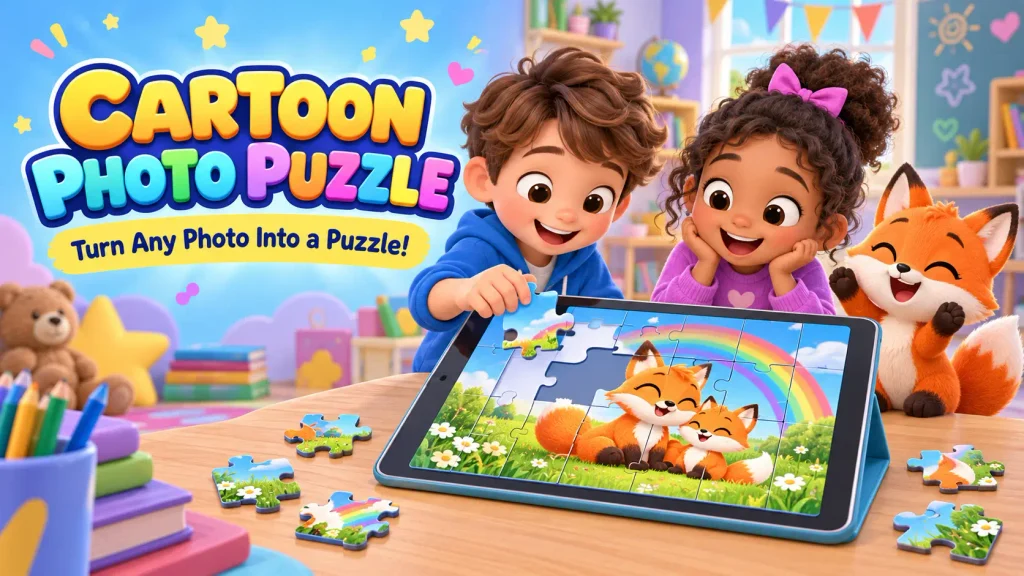
Try the Cartoon Photo Puzzle and turn playtime into a colorful problem-solving activity.
Memory-Matching Games
Memory games usually begin with a collection of face-down cards. Children reveal two cards at a time and try to find matching pictures.
Although the rules are simple, children must pay attention and remember what they previously saw. This makes matching games helpful for visual memory, concentration, turn-taking, and attention to detail.
Alphabet games can help preschool and kindergarten children become familiar with uppercase letters, lowercase letters, beginning sounds, and simple words.
Young learners benefit from activities that connect letters with recognizable objects or sounds. Short, playful sessions can make early reading practice feel less intimidating.
Children encounter numbers everywhere: on clocks, doors, books, calendars, toys, and signs. Number games help them recognize symbols and connect those symbols with quantities.
Depending on the child’s age, an early-math game may include:
Recognizing numbers
Counting objects
Comparing groups
Identifying patterns
Practicing simple addition
Matching numbers with quantities
The goal is not to rush children into advanced mathematics. It is to help numbers become familiar and understandable through play.
Coloring and Creative Games
Educational play does not have to focus exclusively on letters and numbers. Creative games give children opportunities to select colors, experiment with combinations, and create something of their own.
Digital coloring activities can be useful during quiet time, indoor play, or transitions between more structured learning activities.
Word Search Games
Word searches are generally best for children who already recognize letters and are beginning to read simple words. They encourage children to scan carefully, follow letter patterns, and stay focused on a goal.
Younger learners may begin with short words presented in clear horizontal or vertical arrangements. Older children can attempt larger puzzles with words placed in multiple directions.
Cognitive and Logic Games
Logic games invite children to observe, compare, predict, and solve problems. These activities might involve matching objects, identifying differences, completing patterns, navigating mazes, or deciding which item does not belong.
What Are Some Free Educational Games for 3-Year-Olds?
Educational games for three-year-olds should be simple, visual, and forgiving. At this age, children are still learning how to follow instructions, control a mouse or touchscreen, and remain focused on one activity.
Good choices include:
Matching two identical pictures
Sorting objects by color or shape
Completing puzzles with a small number of pieces
Listening to and identifying animal sounds
Coloring large pictures
Counting small groups of objects
Recognizing common letters
Finding basic shapes
Matching objects with their shadows
A three-year-old should be able to understand the main goal quickly. Avoid activities with long written instructions, crowded screens, or penalties for incorrect answers.
Parents and caregivers can make the experience more educational by talking about what appears on the screen. Simple questions such as “What color is that?”, “Which piece comes next?” or “Can you find another animal?” encourage children to describe their thinking.
What Is the Best Game for a 3-Year-Old?
There is no single best game for every three-year-old. The best choice is usually an activity that matches the child’s interests and provides a small, achievable challenge.
For many three-year-olds, a simple picture puzzle or memory-matching activity is an excellent starting point. These games use familiar images, require minimal reading, and allow children to learn through observation.
A suitable game for this age should have:
Large, easy-to-select objects
Bright and recognizable pictures
Simple instructions
Short rounds
Encouraging feedback
No complicated menus
No pressure to finish quickly
If a child becomes frustrated, select an easier activity or play together. Educational games should encourage curiosity, not make a young learner feel tested.
How Can You Entertain a 3-Year-Old Indoors at Home?
Online games can be part of a balanced indoor routine, especially when combined with creative and physical activities.
For example, families can create a simple play sequence:
Complete a short online puzzle.
Name the objects or animals shown in the picture.
Draw or color a related picture.
Count similar objects around the room.
Act out an animal movement or sound.
Read a short story connected to the same theme.
A child who plays an animal-sound game might then imitate the animal, draw it, or find it in a picture book. A number game can lead to counting toys, blocks, or snacks.
These connections help children understand that learning is not limited to a screen. A short online activity can introduce an idea that continues through conversation, movement, art, and imaginative play.
What Is the Best Free Online Game for Kids?
The best free online game is one that is appropriate for the child, easy to access, enjoyable to replay, and connected to a useful skill.
Parents should consider several questions:
Is the activity suitable for the child’s age?
Can the child understand what to do?
Does the game encourage active participation?
Is it building a useful skill?
Does it work without a complicated installation?
Can the child play without creating an account?
Is the experience comfortable on the family’s device?
A colorful game is not automatically educational. The child should be observing, remembering, deciding, creating, counting, reading, or solving something during play.
That does not mean every minute must feel like a lesson. Play and learning can happen together naturally.
Which Educational App Is Totally Free?
Many parents use the word “app” when referring to any interactive activity on a phone or tablet. However, there is an important difference between a downloadable mobile app and a browser-based game.
Free Puzzle Kids provides browser-based educational games rather than requiring families to install a traditional app. Children can open the website and play available free games online without downloading software or creating a child account.
This can be convenient for families who:
Do not want to install another application
Have limited storage space
Use different devices
Prefer not to create an account
Want to begin playing immediately
Visit Free Puzzle Kids to explore the currently available games and activities.
What Is the Best Free Educational App for Kids?
The best educational option depends on what the child needs to practice. Instead of selecting an activity based only on popularity, parents can match the game with a specific learning goal.
Learning goal
Recommended type of game
Concentration
Memory matching
Problem-solving
Puzzles and mazes
Letter recognition
Alphabet games
Early reading
Word and letter games
Counting
Number games
Creativity
Coloring activities
Listening
Animal sound games
Visual reasoning
Matching and logic games
Variety is often more helpful than repeatedly using only one type of activity. A child might complete a puzzle one day, practice letters the next day, and enjoy a creative coloring game afterward.
This gives children multiple ways to learn and helps prevent the experience from becoming repetitive.
How to Choose Educational Games for Children Ages 3–8
Children develop rapidly between ages three and eight. A game that works well for a preschooler may be too easy for a second-grade student.
Ages 3–4
Choose large images, short activities, basic matching, colors, shapes, sounds, and simple puzzles.
Ages 5–6
Introduce letter recognition, beginning sounds, number practice, patterns, memory challenges, and puzzles with more pieces.
Ages 7–8
Look for word searches, logic games, reading activities, math practice, mazes, and more detailed puzzles.
Age labels are helpful, but every child develops differently. Observe whether the game feels too easy, comfortably challenging, or frustrating. The ideal activity allows the child to succeed while still requiring attention and effort.
Benefits of Free Educational Games for Kids Ages 3–8
Well-designed educational games can support several abilities at the same time.
Concentration
Children practice staying with an activity until they reach a goal.
Memory
Matching and recall activities require children to remember images, locations, sounds, or patterns.
Problem-Solving
Puzzles and logic challenges teach children to try different approaches when the first attempt does not work.
Early Literacy
Letter, sound, and word games help children become more comfortable with the building blocks of reading.
Early Math
Counting, comparison, patterns, and number-recognition activities help make mathematical ideas more familiar.
Creativity
Coloring and open-ended activities encourage experimentation and personal expression.
Persistence
Games give children a safe opportunity to make mistakes, try again, and experience the satisfaction of completing a challenge.
Tips for Making Online Learning More Valuable
Parents and teachers do not need to direct every moment of play, but a little participation can make an activity more meaningful.
Try these simple ideas:
Let the child choose between two appropriate games.
Ask the child to explain what they are doing.
Connect the game with objects found at home or in the classroom.
Celebrate effort instead of only correct answers.
Change activities when the child loses interest.
Choose a difficulty level that provides a manageable challenge.
Balance online play with reading, drawing, movement, and conversation.
Short, focused sessions are often more effective than expecting a young child to remain on one activity for a long time.
Play Free Educational Games at Free Puzzle Kids
Free Puzzle Kids offers puzzles, memory activities, letters, numbers, coloring, word games, and other playful learning experiences for young children.
The games are designed to be easy to access from a modern browser, allowing families to begin without downloading an app or creating a child account.
Choose an activity, invite your child to explore, and let learning become part of the adventure.
What are some of the best free learning games for kids?
Puzzles, memory matching, alphabet games, number activities, word searches, coloring games, and logic challenges are among the best free learning games for young children. The right choice depends on the child’s age and learning goals.
What are some free educational games for 3-year-olds?
Good educational games for three-year-olds include simple picture puzzles, color and shape matching, animal sounds, basic counting, large-image coloring activities, and memory games with only a few pairs.
Which educational app is totally free?
Free Puzzle Kids provides free browser-based educational games that can be played online without installing a traditional app. Available games can be opened directly from the website without creating a child account.
What are some free educational games I can play online?
Children can play online puzzles, memory-matching games, alphabet activities, number games, word searches, coloring games, animal-sound activities, and logic challenges.
What is the best free online game for kids?
The best game is one that matches the child’s age, interests, and abilities. For younger children, picture puzzles and matching games are excellent starting points. Older children may enjoy word searches, mazes, number games, and logic challenges.
How can I entertain a 3-year-old indoors at home?
Combine a short educational game with drawing, counting household objects, reading a related story, singing, building with blocks, or acting out animals and characters from the activity.
Do children need to download anything to play?
No download is required for the browser-based games available through Free Puzzle Kids. Children can open a compatible game and play directly online.
Are these educational games suitable for tablets?
Browser-based games can generally be played on modern computers, tablets, and smartphones. The exact experience may vary depending on the game, browser, screen size, and device.
Free Games for Kids Online: Fun, Educational and Easy to Play
Looking for free games for kids online that are fun, simple and suitable for young learners? Free Puzzle Kids offers colorful browser-based games that children can enjoy on a phone, tablet or computer.
There is no complicated installation process. Children can choose a game and start playing directly in their browser. From picture puzzles and memory challenges to letters, words, numbers and animal activities, every game turns screen time into an opportunity to explore and practice useful skills.
Whether you are a parent looking for an engaging activity at home or a teacher searching for a quick classroom brain break, these free online kids’ games make it easy to combine entertainment and learning.
What Games Can Kids Play Online for Free?
Children can play many different types of games online, but the best choice depends on their age, interests and current learning needs.
At Free Puzzle Kids, young players can explore activities involving:
Jigsaw puzzles and picture puzzles
Memory and matching
Letters and early vocabulary
Word searches
Numbers and simple problem-solving
Animal recognition and sounds
Colors, shapes and visual patterns
Geography and country flags
Creative picture-based activities
These games are designed to feel playful rather than like formal schoolwork. Children can experiment, make mistakes and try again while building confidence through practice.
Puzzle games are a simple way to encourage children to slow down, observe details and think about how different pieces fit together.
While solving a puzzle, a child may practice:
Visual recognition
Hand-eye coordination
Spatial reasoning
Concentration
Patience
Problem-solving
One special option is the Free Photo Puzzle Maker for Kids. Parents can select a family photo, pet picture, drawing or another favorite image and instantly transform it into a playable puzzle.
The selected picture stays on the device and is not uploaded, stored or shared. Children can choose between 16, 25 and 36 pieces, allowing adults to adjust the challenge for different ages and abilities.
Memory Games for Young Children
Memory games invite children to observe cards, remember their positions and find matching pairs. The rules are easy to understand, but every round encourages careful attention.
These activities can help children practice:
Short-term memory
Visual recall
Matching
Focus
Turn-taking
Persistence
The Ocean Memory Game introduces children to a friendly underwater theme while they search for matching sea animals. It is especially suitable for younger learners who are beginning to understand matching games.
Word and letter games can make early literacy practice feel more approachable. Instead of completing a traditional assignment, children interact with letters, discover hidden words and solve small language challenges.
Depending on the activity, children may practice:
Letter recognition
Beginning sounds
Spelling
Vocabulary
Reading direction
Visual scanning
A word search, for example, encourages children to examine a group of letters carefully and identify a target word. This can be particularly helpful for young readers who enjoy solving visual challenges.
Short, repeatable word activities are useful at home, during homeschool lessons, in learning centers or as a classroom brain break.
Number Games and Early Math Practice
Free online games can also reinforce early number skills. Young learners often benefit from seeing numbers in different playful situations rather than only completing written exercises.
Number games may help children practice:
Number recognition
Counting
Comparing quantities
Identifying patterns
Simple calculations
Logical thinking
A short math game can be used as warm-up practice before a lesson or as an enjoyable review after children complete their regular work.
Animal Sounds and Recognition Games
Animal activities are popular with preschool and early-elementary children because they connect familiar pictures with sounds and names.
While playing an animal recognition game, children can listen, observe and make connections between an animal’s appearance and the sound it makes. These activities may encourage vocabulary development, listening and classification.
Parents can extend the experience away from the screen by asking questions such as:
Where does this animal live?
What does it eat?
Is it a farm animal or a wild animal?
Can you imitate its sound?
How does it move?
This turns a simple game into a broader conversation and learning opportunity.
Educational Cognitive Games for Kids
Some games combine memory, reasoning, matching and attention in the same activity. These are often described as cognitive games because they encourage children to use several thinking skills together.
Free Puzzle Kids includes a collection of educational cognitive games for kids involving concentration, visual recognition, logic and problem-solving.
The objective is not to pressure children or measure intelligence. The games simply provide enjoyable opportunities to observe, think, choose and try again.
What Is the Best Free Kids’ Game?
There is no single game that will be best for every child. A good game should match the child’s age, interests and current abilities.
For example:
A preschooler may enjoy animal sounds, colors and simple matching.
A child learning letters may prefer alphabet or word games.
A visual learner may enjoy puzzles and picture-matching activities.
A child who likes challenges may prefer memory or logic games.
A creative child may enjoy making a personalized photo puzzle.
The best free kids’ game is one that a child understands, enjoys and can play without becoming overwhelmed.
Adults should begin with an easy activity and increase the difficulty gradually. A game that is slightly challenging can encourage growth, but a game that is far beyond the child’s current level may quickly become frustrating.
Can Kids Play Without Downloading Anything?
Yes. Browser games can be played without downloading a traditional app or installing software.
Free Puzzle Kids games run online through a modern web browser. Depending on the game, children can play on:
Desktop computers
Laptops
Tablets
Smartphones
Playing in the browser is convenient for parents and teachers because it reduces setup time. It also allows children to move between compatible devices without installing a separate application on each one.
For the best experience, use an updated browser and a stable internet connection.
Are These Games Completely Free?
The children’s games available in the free-play section of Free Puzzle Kids can be played online without purchasing a subscription.
Free Puzzle Kids also offers separate premium resources for adults, including teacher web apps and printable worksheets. Those professional resources are not required for children to access the free games.
Keeping the two areas separate makes the choice clear: children can enjoy the free game collection, while teachers and parents may optionally explore additional classroom materials.
Are Free Online Games Safe for Children?
Parents should always review a website before allowing a young child to use it independently. A child-friendly game should have understandable controls, age-appropriate content and no need for children to communicate with strangers.
Free Puzzle Kids focuses on individual educational activities rather than social networking or open player-to-player chat.
Adults can make online play safer by:
Choosing the game before handing over the device
Remaining nearby when younger children play
Using a child-friendly browser configuration
Setting a reasonable play period
Avoiding websites that request unnecessary personal information
Talking with children about what they see online
For personalized activities such as the Photo Puzzle Maker, the selected picture is processed inside the browser and stays on the user’s device.
How Long Should Children Play Online Games?
There is no single play period that works for every family. The child’s age, routine and the type of activity all matter.
A short game session can be enough for a preschooler. Older children may remain engaged for longer, especially when they are solving puzzles or completing a learning challenge.
Adults can create a healthier balance by combining online play with:
Drawing or coloring
Reading together
Outdoor movement
Building toys
Printable activities
Conversation about what the child learned
The goal is not simply to increase screen time. It is to make the time children already spend with technology more purposeful and interactive.
How Parents Can Turn a Game into a Learning Activity
A few simple questions can transform casual play into a richer learning experience.
Before playing, ask:
What do you think this game will be about?
Which level should we try first?
What do you already know about this topic?
During the game, ask:
What did you notice?
Why do you think that answer works?
Can you find another pattern?
What could you try next?
After playing, ask:
What was the easiest part?
What was challenging?
What new word, number or animal did you discover?
Would you like to play again at a harder level?
These conversations encourage children to explain their thinking instead of only tapping the screen.
Free Online Games for Home and Classroom Use
Parents can use educational games as a rainy-day activity, a quiet-time option or a short learning break.
Teachers can incorporate them into:
Classroom learning centers
Morning arrival activities
Early-finisher time
Technology stations
Small-group practice
Indoor recess
Lesson review
Brain breaks
Because browser games require little preparation, teachers can open an activity and allow students to begin quickly.
Start Playing Free Games for Kids
Free online games can provide much more than entertainment. A thoughtfully selected activity can encourage children to concentrate, recognize patterns, remember information and solve age-appropriate problems.
Free Puzzle Kids brings these experiences together in one colorful place for young explorers. Children can solve puzzles, practice letters and numbers, discover animal sounds and enjoy playful educational challenges directly in their browser.
Visit Free Puzzle Kids and choose your child’s next free learning adventure.
Frequently Asked Questions
What games are completely free for kids?
Free Puzzle Kids offers browser-based puzzles, memory activities, word games, number challenges and other educational games that children can play online. The free children’s games do not require a paid teacher subscription.
What are some free online games for kids?
Children can play picture puzzles, memory games, word searches, letter activities, number games, animal-sound games and geography challenges. The best option depends on the child’s age and interests.
Can children play these games without downloading anything?
Yes. The games work directly in a compatible web browser, so there is no traditional application to download or install.
What is the best free game for kids?
The best game is one that matches the child’s age, interests and abilities. Younger children may enjoy matching and animal activities, while older children may prefer word searches, puzzles and logic challenges.
Are free games really free?
The games in the Free Puzzle Kids play area are free to access. Printable worksheet products and professional teacher apps are separate optional resources.
Are there free kids’ games without an account?
Yes. Children can access the free games without creating a player account. Some separate store or teacher services may use accounts for purchases and access management.
Do the games work on tablets and phones?
Many Free Puzzle Kids activities are designed to work in modern browsers on computers, tablets and smartphones. Screen size and browser compatibility may affect individual games.
Are online educational games useful for children?
They can be useful when the activity is appropriate for the child’s age and is balanced with reading, conversation, creative play and physical movement. Games can provide additional practice with memory, letters, numbers, matching and problem-solving.
Benefits of Educational Games for Kids at Home and School
Why Educational Games Matter for Young Learners
Finding high-quality free games for kids should not be difficult. Children love to play, explore, solve problems, and discover new things—and the right online games can turn those natural interests into meaningful learning experiences.
At Free Puzzle Kids, children can enjoy fun educational games designed to encourage creativity, memory, concentration, early literacy, problem-solving, and independent learning. Our activities are created especially for young learners, parents, and teachers who want screen time to feel playful and purposeful.
Whether your child enjoys puzzles, coloring, matching pictures, learning letters, recognizing sounds, or exploring new challenges, there is something fun waiting to be played. Best of all, our free online games are easy to access directly from a browser, with no complicated setup required.
Why Are Educational Games Good for Kids?
Play is one of the most natural ways for children to learn. When children play an educational game, they are not simply looking at a screen. They are making decisions, testing ideas, remembering patterns, coordinating movements, and learning from their mistakes.
Well-designed educational games can help children develop important abilities, including:
Memory and concentration
Hand-eye coordination
Logical thinking and problem-solving
Letter, number, color, and shape recognition
Creativity and imagination
Patience and persistence
Confidence when completing a challenge
The most effective learning games do not make children feel as though they are completing a lesson. Instead, they make practice feel like an enjoyable adventure. A child may repeat the same activity several times because it is entertaining, and that repetition can strengthen developing skills.
Free Online Games for Kids at Free Puzzle Kids
Every child has different interests and learns in a different way. That is why Free Puzzle Kids offers several types of activities rather than a single style of game. Children can choose a quiet puzzle, a creative coloring activity, a memory challenge, or a lively learning adventure.
Here are some of the experiences children can explore.
Puzzle Games
Puzzles encourage children to look closely, compare details, recognize patterns, and think about how individual pieces fit together. They are a simple but powerful way to exercise visual-spatial reasoning and problem-solving skills.
Our puzzle activities give young players an opportunity to work at their own pace. Finishing a puzzle can also provide a satisfying sense of accomplishment, especially when a child solves it independently.
Memory Matching Games
Memory games ask children to remember the location of pictures and find matching pairs. Although the idea is easy to understand, every round provides valuable practice in attention, visual memory, and concentration.
These games are useful for short learning breaks at home or in the classroom. Children can try to improve their performance while enjoying colorful, friendly images.
Coloring Games
Digital coloring gives children space to experiment with colors and express their creativity. They can make unusual combinations, change their choices, and create a picture that feels completely their own.
Coloring activities may also support color recognition, careful movement, and creative decision-making. They are particularly helpful when children need a calm activity after a busy lesson or an energetic part of the day.
Letter and Word Games
Early literacy grows through regular exposure to letters, sounds, and words. Letter and word games can make this practice more inviting by giving children a clear goal and immediate interaction.
Young learners can become more familiar with the alphabet, notice letter patterns, and build confidence with foundational language concepts. These activities can complement reading practice with a parent, caregiver, or teacher.
Animal Sound Games
Children are naturally curious about animals and the sounds they make. Animal sound activities combine listening, recognition, and visual clues to create an engaging learning experience.
They can encourage children to connect an animal with its sound while practicing careful listening. Parents and teachers can extend the activity by asking where each animal lives, what it eats, or how it moves.
Creative Photo Puzzles
Some children are especially motivated when an activity includes a familiar image. A creative photo puzzle allows a parent or caregiver to choose an appropriate picture and transform it into a personalized puzzle experience.
This can make puzzle play feel exciting and unique. Families should always supervise young children and choose images that are safe and suitable for their age.
Learning Through Play at Home
Parents do not need to turn every game into a formal lesson. A few simple questions can encourage children to think and talk about what they are doing:
What do you notice in this picture?
Which piece do you think belongs here?
Can you remember where you saw the matching card?
What color would you like to use next?
What strategy could you try?
Can you tell me how you solved it?
These conversations help children describe their thinking and can introduce useful vocabulary. Just as importantly, they show children that effort and experimentation matter.
A short period of focused play is often more valuable than a long session that leaves a child tired or frustrated. Parents can choose an activity appropriate for the child’s age, remain nearby when needed, and allow the child to stop or switch games when attention begins to fade.
Free Games for Kids in the Classroom
Teachers can use online games as flexible classroom resources. A game may be included in a learning center, used during indoor recess, offered as an early-finisher activity, or played during a short transition between lessons.
Educational games can also provide an alternative way to practice a skill. A child who feels hesitant during a worksheet activity may feel more comfortable exploring the same type of concept through play.
Possible classroom uses include:
A memory game during a concentration station
A puzzle as an early-finisher activity
A coloring game during a calm classroom break
A letter activity for early literacy practice
An animal sound game during a science or listening lesson
A supervised game displayed on an interactive whiteboard
Teachers can invite children to play individually, work with a partner, or solve a challenge together as a group. The goal is not simply to keep students occupied, but to select an activity that fits the classroom moment and the learners’ needs.
Choosing Age-Appropriate Online Games
Not every game is right for every child. When selecting free games for kids, parents and educators should consider the child’s age, interests, reading level, coordination, and ability to follow instructions.
A suitable game should offer a manageable challenge. If it is too easy, the child may lose interest. If it is too difficult, the child may become frustrated. The ideal activity encourages the player to think while still providing a realistic path to success.
Adults should also look for:
Clear and simple instructions
Large, easy-to-use controls
Child-friendly images and language
A calm design without unnecessary distractions
Activities that reward effort and progress
Content appropriate for young learners
Supervision remains important, particularly for younger children. Playing together for the first few minutes can help an adult confirm that the activity is appropriate and show the child how the controls work.
Making Screen Time More Meaningful
Screen time is not all the same. Watching videos passively and interacting with a problem-solving game are different experiences. Educational games can invite children to make choices, recall information, create something, or respond to a challenge.
However, online play should be part of a balanced day. Children also need physical movement, conversation, imaginative play, books, art, outdoor experiences, and rest. A digital game works best as one useful activity among many.
Adults can make game time more meaningful by connecting it to an offline activity. After completing an animal game, a child could draw a favorite animal. After playing a letter game, the child could look for that letter in a book. After finishing a puzzle, the family could build a physical puzzle together.
These simple connections help move learning beyond the screen.
Why Families and Teachers Choose Free Puzzle Kids
Free Puzzle Kids brings playful learning activities together in one convenient place. The website is designed for families and educators looking for approachable activities for young children.
Our goal is simple: help children learn, play, and grow through enjoyable experiences. There is no need to make learning feel heavy or stressful. A colorful puzzle, a matching challenge, or a creative activity can inspire curiosity and give children another opportunity to practice important skills.
Along with online games, Free Puzzle Kids also offers educational resources and printable worksheets for parents and teachers. This makes it easier to combine digital learning with hands-on practice.
Start Playing Free Games for Kids Today
Children learn best when they feel curious, comfortable, and involved. The right game can capture their attention while encouraging them to observe, remember, experiment, and solve problems.
Explore the collection of free games for kids at Free Puzzle Kids and choose an activity that matches your child’s interests. Try a puzzle, test your memory, create a colorful picture, practice letters, or discover animal sounds.
There is always something new to learn—and learning can begin with play.
[Explore Free Educational Games for Kids]
Frequently Asked Questions
Are the games on Free Puzzle Kids free?
Yes. Children can play the free games available on Free Puzzle Kids directly online. The website also offers separate educational resources and premium tools for parents and teachers.
What ages are these games designed for?
Many activities are designed for young children, particularly preschool, kindergarten, first-grade, and second-grade learners. Parents and teachers should select games based on each child’s individual ability and interests.
Do children need to download an app?
No download is needed for the browser-based games. Children can open a compatible web browser and begin playing online.
Can teachers use these games in the classroom?
Yes. Teachers can use them for learning centers, early-finisher activities, indoor breaks, supervised technology time, or additional skill practice.
Can educational games replace regular lessons?
Educational games are best used as a complement to teaching, reading, conversation, creative play, physical activity, and hands-on learning. They provide another enjoyable way for children to practice useful skills.
How can parents make online gaming safer?
Parents can remain nearby, choose age-appropriate activities, establish reasonable time limits, and talk with children about what they are playing. Young children should use the internet with adult guidance.
Finding fun, safe, and educational activities for children does not have to be complicated. Free puzzle games for kids online give children an easy way to play, think, explore, and learn directly from a computer, tablet, or phone.
Puzzle games are especially useful because children are not simply watching a screen. They are making decisions, recognizing patterns, matching shapes, remembering locations, testing solutions, and solving problems.
At Free Puzzle Kids, our goal is simple: make learning feel like play.
Children can explore colorful games, puzzles, memory activities, educational challenges, and interactive experiences designed to keep young minds engaged while having fun.
Whether your child enjoys jigsaw puzzles, memory games, matching activities, letters, numbers, animals, colors, or problem-solving challenges, online puzzle games can provide an entertaining way to practice important skills.
Why Free Puzzle Games for Kids Online Are So Popular
Parents and teachers are constantly searching for activities that children actually enjoy.
Traditional worksheets can be useful, but young children often respond especially well to interactive activities where they can immediately see what happens after making a choice.
That is one reason free puzzle games for kids online have become such a useful option for families and classrooms.
Children can start playing quickly, experiment with different solutions, and continue trying until they solve the challenge.
Puzzle games can also be played in short sessions.
A child might complete a puzzle during a classroom break, while waiting for dinner, during quiet time, or as part of a learning activity at home.
The experience does not need to feel like homework.
For many children, the learning happens naturally while they are focused on completing the game.
Puzzle Games Turn Screen Time Into Active Play
Not all screen time is the same.
Watching videos is mostly passive. The child watches while the content continues automatically.
Puzzle games are different.
The player must participate.
A puzzle might ask a child to:
Find two matching objects.
Move pieces into the correct position.
Recognize a letter or number.
Remember where an image appeared.
Identify an animal.
Complete a sequence.
Solve a maze.
Choose the correct shape.
Match colors.
Put objects in the correct order.
These small decisions transform the screen from something children simply watch into something they actively use.
Interactive puzzle play can therefore be a useful addition to a balanced collection of childhood activities.
What Skills Can Kids Practice With Online Puzzle Games?
Good puzzles can involve several skills at the same time.
A child solving a simple picture puzzle, for example, may be looking at shapes, remembering the original image, comparing colors, moving pieces, and correcting mistakes.
Here are some of the most important abilities children can practice.
Problem-Solving
Every puzzle presents a small problem.
Where does this piece belong?
Which object matches?
What should happen next?
Which path reaches the goal?
Children begin making predictions and testing possible answers.
When one solution does not work, they can try another.
This process helps children become more comfortable with experimentation and persistence.
Memory
Memory games are a natural companion to puzzles.
Children might need to remember:
Where a picture appeared.
Which cards have already been revealed.
The position of an object.
The order of a sequence.
A previously shown pattern.
Because the activity feels like a game, children may practice these skills repeatedly without thinking of it as formal study.
Visual Recognition
Many children’s puzzles involve identifying similarities and differences.
A child may compare:
Colors.
Shapes.
Animals.
Letters.
Numbers.
Patterns.
Objects.
Pictures.
Visual discrimination is useful in many early-learning activities, including reading and mathematics.
Spatial Thinking
Jigsaw puzzles are particularly good examples of spatial challenges.
Children have to understand how individual pieces relate to a larger picture.
They may mentally rotate objects, compare edges, identify corners, or predict where something belongs.
Online puzzles can introduce these ideas in a simple and colorful way.
Concentration
Completing a puzzle usually requires staying focused long enough to reach the goal.
Even a small puzzle can encourage a child to concentrate on one task for several minutes.
The challenge can gradually become more complex as the child’s abilities develop.
Fine Motor Coordination
When children use a touchscreen, trackpad, or mouse, they often need to drag, tap, select, and position objects accurately.
These actions can provide additional practice coordinating visual information with hand movements.
Different Types of Free Puzzle Games for Kids Online
Not every child enjoys the same type of puzzle.
Fortunately, online games can offer many different formats.
Jigsaw Puzzle Games
Jigsaw puzzles are among the most recognizable children’s puzzles.
The objective is simple: put several pieces together until they form a complete image.
For younger children, puzzles can contain only a few large pieces.
Older children may enjoy increasingly complicated pictures with more pieces and less obvious solutions.
Animal pictures, cartoons, vehicles, nature scenes, dinosaurs, and colorful characters can make jigsaw puzzles especially appealing.
Memory Matching Games
Memory games usually hide pairs of pictures.
Children reveal two cards at a time and try to remember where matching images are located.
These games can help children practice attention and visual memory while working toward a clear goal.
They are also easy to understand, making them useful for younger players.
Maze Games
Mazes challenge children to find a path from one location to another.
Simple mazes may require only a few decisions, while harder ones can involve many turns and dead ends.
Maze games encourage planning and spatial reasoning.
They also teach an important lesson: choosing the wrong direction does not mean the game is over.
The child simply tries another route.
Matching Games
Matching activities can involve colors, shapes, animals, letters, words, numbers, or objects.
A child might match:
An animal to its picture.
A number to a quantity.
A letter to an object beginning with that letter.
Two identical shapes.
An object to its shadow.
Matching games can combine entertainment with early-learning concepts.
Logic Games
Logic puzzles ask children to look for relationships and rules.
These activities may involve sequences, patterns, categories, comparisons, or simple deduction.
For younger children, logic games should remain visually clear and easy to understand.
As children grow, challenges can gradually require additional steps.
Letter and Word Puzzles
Puzzle games can also support early literacy.
Children might identify letters, complete words, recognize beginning sounds, or arrange letters in the correct order.
The game format can make repeated literacy practice more engaging.
Number and Math Puzzles
Numbers can also become part of puzzle play.
Children might:
Match numbers.
Count objects.
Solve simple addition.
Complete number patterns.
Compare quantities.
Identify missing numbers.
This type of activity introduces mathematical thinking through interaction rather than memorization alone.
Free Puzzle Games for Preschoolers
Preschoolers generally benefit from simple games with clear objectives.
For children around ages three to five, puzzles should avoid unnecessary complexity.
Good choices can include:
Large-piece jigsaw puzzles.
Animal matching games.
Color recognition.
Shape matching.
Simple memory games.
Basic letter recognition.
Easy counting activities.
At this stage, completing the activity successfully is often more valuable than making the puzzle difficult.
A game that is too complicated can quickly become frustrating.
A game that provides an achievable challenge encourages children to keep exploring.
Puzzle Games for Kindergarten Kids
Kindergarten children can usually handle slightly more complex challenges.
Activities might include:
Alphabet puzzles.
Beginning-sound matching.
Number sequences.
Simple addition.
Pattern recognition.
Memory challenges.
Multi-piece jigsaw puzzles.
Easy logic games.
Children at this age are developing rapidly, so having different types of games available helps them explore several learning areas.
Puzzle Games for First and Second Grade
As children progress through elementary school, puzzle games can begin incorporating more academic content.
Activities may involve:
Spelling.
Addition and subtraction.
Vocabulary.
Reading.
Geography.
Science concepts.
Logical sequences.
More complicated mazes.
The objective should still remain playful.
Children are often more willing to practice a challenging skill when it appears inside a game.
Why Children Like Puzzle Games
Puzzle games provide something children naturally enjoy: a challenge with a visible solution.
The child knows there is something to complete.
That final result might be:
A finished picture.
A matched pair.
A completed maze.
A solved pattern.
A correct answer.
A completed word.
This gives the player a clear sense of progress.
Every correct move brings the child closer to finishing.
Unlike activities where success can seem vague, puzzles usually provide immediate feedback.
The piece fits.
The cards match.
The path works.
The answer is correct.
That makes the activity easy for children to understand.
Puzzle Games Can Encourage Persistence
One of the most useful lessons puzzles can provide is that the first answer does not always work.
A child may place a piece in the wrong location.
That is not a disaster.
The child can move it somewhere else.
A maze may lead to a dead end.
The player can return and choose another route.
A memory card may not match.
The child can remember its location for the next attempt.
Puzzle games repeatedly create these tiny opportunities to try again.
Over time, children can become more comfortable with making mistakes and testing alternatives.
Playing Puzzle Games at Home
Parents can use free online puzzles in many different ways.
They can become part of:
Quiet-time activities.
Weekend play.
Rainy-day entertainment.
Homework breaks.
Learning practice.
Family game time.
Parents can also play alongside younger children.
Instead of immediately giving the answer, adults can ask questions such as:
“Where do you think this piece belongs?”
“What did you notice?”
“Do you remember where the other picture was?”
“Which path should we try?”
These questions encourage the child to explain their thinking.
Using Puzzle Games in the Classroom
Teachers can also incorporate online puzzles into classroom routines.
For example, puzzle games may work well for:
Early Finishers
Students who complete their work early can play an appropriate puzzle while classmates finish.
Learning Centers
A computer or tablet station can include puzzle activities related to letters, numbers, matching, or problem-solving.
Brain Breaks
Short interactive games can provide a change of pace between lessons.
Review Activities
Teachers can use educational games to reinforce concepts children have already studied.
Independent Practice
Children can work through a game individually and make decisions without needing constant instructions.
The exact approach depends on the age of the students and the classroom routine.
Free Puzzle Games Without Downloads
One advantage of browser-based games is convenience.
Many families prefer activities that can start without installing additional software.
Browser games can often be opened directly from a webpage and played immediately.
This makes them practical on:
Desktop computers.
Laptops.
Tablets.
Smartphones.
Parents do not have to fill a device with dozens of individual game apps simply to provide several different activities.
Online Puzzle Games for Tablets
Tablets work particularly well for many children’s puzzles because touching and dragging objects feels intuitive.
A young child can often understand dragging a puzzle piece before becoming comfortable using a traditional mouse.
Large buttons, clear pictures, and simple controls make the experience easier.
For younger children especially, straightforward interfaces are important.
Puzzle Games on Computers
Computers can also provide an excellent puzzle-playing experience.
A larger screen makes it easier to view detailed images and larger puzzles.
Older children may prefer playing logic games, mazes, memory challenges, or more advanced puzzles with a mouse or trackpad.
Classrooms with computers can also use browser games without needing individual tablets for every child.
Choosing the Right Puzzle Difficulty
The best puzzle is not necessarily the hardest one.
Children benefit from challenges that are difficult enough to require thought but still possible to complete.
If a puzzle is extremely easy, the child may quickly lose interest.
If it is far too difficult, the child may become frustrated.
Parents and teachers can gradually increase the challenge as children’s skills improve.
For example:
A preschooler might begin with a four-piece puzzle.
Later, the child might move to six or eight pieces.
Eventually, larger puzzles can be introduced.
The same principle works with memory games, logic puzzles, letters, and math challenges.
Educational Puzzle Games Can Make Practice More Enjoyable
Repetition is an important part of learning.
Children frequently need to practice the same concepts more than once.
The challenge is keeping that repetition interesting.
Games can provide another way to practice familiar skills.
A child learning numbers might complete a number puzzle.
A child practicing the alphabet might play a letter-matching game.
A child learning animal names might solve an animal puzzle.
The educational objective is still present, but the presentation feels different.
Puzzle Games and Independent Learning
One useful feature of many puzzles is that children can often understand whether their solution works without an adult correcting every step.
A puzzle piece fits or it does not.
Two memory cards match or they do not.
A maze reaches the destination or it does not.
This immediate feedback encourages independent exploration.
Children can test ideas and make corrections themselves.
That independence can make learning activities feel more like discovery.
Free Puzzle Games for Kids Online at Free Puzzle Kids
Free Puzzle Kids is built around the idea that children should be able to learn while having fun.
The website offers free educational activities and games designed for young learners.
Children can explore different types of interactive play, including puzzles and other learning games.
Instead of treating education and entertainment as completely separate experiences, Free Puzzle Kids brings them together.
Children can practice thinking, matching, remembering, recognizing, and problem-solving while enjoying colorful interactive activities.
More Than Just Puzzle Games
Although puzzles are an important part of learning through play, children benefit from variety.
Free Puzzle Kids also gives families the opportunity to explore different kinds of educational games.
Changing between activities can help keep children interested.
One day they might work on a puzzle.
Another day they might practice memory.
Later they might explore letters, animals, colors, or another interactive challenge.
Variety can keep learning fresh while giving children opportunities to exercise different skills.
How Long Should Kids Play Puzzle Games?
There is no single amount of time that works for every family.
A puzzle session can be short.
Even five or ten minutes may be enough for a child to complete a few challenges.
The important thing is that online play remains part of a broader variety of activities.
Children also need opportunities to move, talk, draw, build, read, explore, imagine, and interact with other people.
Online puzzle games work best as one activity among many.
Can Parents Play Too?
Absolutely.
Puzzle games can become shared activities.
Adults can sit beside children and solve problems together.
Parents might intentionally avoid giving the answer immediately and instead encourage the child to think.
For example:
“What happens if we try this piece?”
“Which two pictures look the same?”
“Where did you see that animal before?”
“What shape are we looking for?”
These conversations can turn a simple game into an opportunity for children to describe what they are thinking.
Are Puzzle Games Good for Learning?
Puzzle games can support several kinds of practice when they are appropriate for the child’s age and ability.
They can encourage:
Concentration.
Memory.
Visual recognition.
Problem-solving.
Pattern recognition.
Spatial thinking.
Persistence.
Hand-eye coordination.
Educational puzzles can additionally reinforce concepts involving numbers, letters, vocabulary, shapes, animals, colors, and other early-learning topics.
The most effective games are usually those children enjoy enough to play repeatedly.
Frequently Asked Questions About Free Puzzle Games for Kids Online
What are free puzzle games for kids online?
Free puzzle games for kids online are interactive games children can play through a web browser without purchasing the game. They may include jigsaw puzzles, memory games, mazes, matching activities, logic puzzles, letter games, and number challenges.
Do kids need to download puzzle games?
Many browser-based puzzle games can be played directly online without installing an application. This makes them convenient for computers, tablets, and smartphones.
What age can children start playing online puzzles?
Simple puzzles can be suitable for preschool-age children when the controls and difficulty match their developmental level. Older children can gradually move toward more complicated puzzles involving logic, memory, reading, mathematics, and strategy.
Are puzzle games educational?
They can be. Puzzle games may involve problem-solving, visual recognition, memory, spatial reasoning, concentration, matching, sequencing, and other useful skills. Educational puzzles may also include letters, numbers, vocabulary, and school-related concepts.
What puzzle games are best for preschoolers?
Preschoolers often do well with large-piece jigsaw puzzles, simple matching activities, animal puzzles, color games, shape recognition, basic memory games, and easy letter or number activities.
Can teachers use online puzzle games in the classroom?
Yes. Teachers can use age-appropriate puzzle games for learning centers, independent practice, early finishers, review activities, or short classroom breaks.
Can puzzle games help children with problem-solving?
Puzzle games regularly present small problems children must solve. They encourage children to test ideas, recognize mistakes, change strategies, and continue trying until they complete the challenge.
Can children play puzzle games on an iPad or tablet?
Many browser-based puzzle games work on modern tablets and touchscreen devices. Games with drag-and-drop controls can be particularly intuitive for young children.
Are online puzzle games better than regular puzzles?
They serve different purposes. Physical puzzles provide hands-on play, while online puzzles provide convenience, variety, interactive feedback, and easy access to many activities. Children can benefit from experiencing both.
Start Playing Free Puzzle Games for Kids Online
Learning does not always need to look like a lesson.
Sometimes it can begin with a colorful picture, a missing puzzle piece, a matching card, a maze, or a simple challenge waiting to be solved.
Free puzzle games for kids online give children an opportunity to think actively while enjoying themselves.
They can practice memory, concentration, pattern recognition, visual skills, spatial thinking, and problem-solving while playing at their own pace.
For parents, they provide an easily accessible activity.
For teachers, they can provide another way to support learning.
And for children, the most important part is much simpler:
They get to play.
Explore Free Puzzle Kids and discover educational games designed to make learning entertaining, interactive, and fun.
post
Best Free Classroom Games for Early Finishers
Every teacher knows the moment. Most of the class is still working, but one student has already placed a finished assignment on the desk and asks, “What do I do now?” It may happen five minutes earlier than expected, or it may happen before the teacher has finished helping another student. Without a clear routine, that innocent question can interrupt small-group instruction, distract classmates, and leave the early finisher without a meaningful challenge.
The best free classroom games for early finishers solve more than a time-management problem. They provide purposeful activities that reinforce learning, stimulate curiosity, and allow students to work independently. Instead of rewarding efficient work with another repetitive worksheet, teachers can offer puzzles, memory challenges, letter games, number activities, logic problems, and creative extensions.
Free Puzzle Kids provides free browser-based educational games covering puzzles, letters, numbers, memory, creativity, and cognitive skills. Children can access its free games without creating a player account, providing a name, or submitting an email address. Many activities require no download and work on classroom computers and tablets, making them practical additions to a teacher-curated early-finisher station.
The objective is not to keep fast workers silently occupied at any cost. Early-finisher time should remain part of the learning day. With a carefully selected menu of independent games, teachers can protect the concentration of students who are still working while giving early finishers worthwhile opportunities to think, practice, and explore.
Why Early Finishers Need Meaningful Choices
Students complete classroom assignments at different speeds for many reasons. Some understand the material quickly, some have strong concentration, and others may already possess the skill being practiced. A few appear to finish early because they rushed, skipped instructions, or provided incomplete answers. An effective early-finisher routine needs to account for all these possibilities.
Before moving to a game, students should know how to check their work. A simple classroom rule can require them to reread the instructions, confirm that every question is answered, and improve anything that was completed carelessly. The game is not an escape from the original assignment; it is an appropriate next step after quality work.
Once the assignment is genuinely complete, the early finisher deserves something better than meaningless repetition. Giving a child additional pages of the same work can unintentionally teach that finishing efficiently results in a penalty. Some students may eventually slow down on purpose to avoid receiving more work.
Meaningful games provide a different kind of extension. They can reinforce an essential skill, present a deeper challenge, allow creative application, or give the child a choice among several learning areas. The student remains engaged without simply repeating what everyone else is still completing.
A predictable system also supports the entire class. Students who know exactly where to go and what to do are less likely to interrupt the teacher. Those still working experience fewer distractions, and the teacher can continue providing support where it is most needed.
Enrichment Versus Busy Work
Busy work exists primarily to fill time. It may keep a student occupied, but it has little connection to an instructional goal and often requires minimal thought. Copying long lists, completing unnecessary duplicate pages, or coloring without a creative or academic purpose may produce silence without producing meaningful engagement.
Enrichment extends learning. It may ask a student to use familiar knowledge in a new way, solve a more demanding problem, practice independently, make a connection, or create something original. A puzzle that requires spatial reasoning, a memory game that reinforces concentration, or a word challenge that develops vocabulary can all function as enrichment.
This distinction does not mean every early-finisher task must be difficult. Students sometimes need a calm activity after concentrated work. The important question is whether the activity still offers value. A simple matching game may provide useful fluency practice for one child, while another requires a more advanced logic challenge.
Choice can make enrichment more effective. A small menu containing literacy, mathematics, problem-solving, and creative options allows children to select an activity that matches their interests. Teachers can still limit the choices according to current learning goals and individual needs.
The ideal early-finisher game feels enjoyable to the student while remaining defensible as part of the school day. It does not exist merely to stop the child from asking what comes next.
What Makes a Game Suitable for Early Finishers?
An early-finisher game must be understandable without repeated teacher assistance. If every player needs a personal explanation, the game will interrupt the very instruction the system was designed to protect. Teachers should introduce each option to the whole class before adding it to the independent station.
The activity should also be easy to begin and stop. An early finisher may have only five minutes before the class transitions to another lesson. Games containing short rounds, individual puzzles, or clearly defined levels work better than activities requiring lengthy setup.
Classroom volume matters. A game should function with headphones, low sound, or no sound at all. Avoid activities that encourage shouting, constant competition, or unnecessary movement near students who are still concentrating.
High-quality choices should require meaningful participation. Students ought to compare, remember, calculate, identify, solve, create, or explain. Repetitive tapping without thought may be entertaining, but it is not the strongest use of instructional time.
Finally, the activity must be appropriate for the student’s age and current skills. A preschool alphabet game will not challenge an advanced third grader, while a complex crossword can frustrate a beginning reader. A varied menu makes differentiation possible without creating an entirely separate system for every child.
Ten Free Classroom Games for Students Who Finish Early
The following collection combines free online games from Free Puzzle Kids with simple classroom extensions. Teachers can select the options that match their students’ ages, devices, learning goals, and ability to work independently.
1. Fun Free Online Puzzle
The Fun Free Online Puzzle collection invites children to solve visual and spatial challenges. Students examine shapes, colors, picture details, and positions before deciding where each piece belongs. Every attempted placement provides immediate feedback.
Online puzzles work well for early finishers because they require little setup and can be completed independently. They reinforce observation, spatial reasoning, planning, concentration, and persistence. Students must adjust their strategies when a piece does not fit instead of waiting for the teacher to supply an answer.
Before adding the game to the early-finisher menu, demonstrate how to choose an appropriate puzzle and use the controls. Establish whether students may complete one puzzle or continue until the transition signal.
For an additional challenge, ask students to describe the strategy they used. They might write or draw a brief response explaining whether they began with corners, matching colors, recognizable picture sections, or another clue.
2. ABC Letters and Numbers
ABC Letters and Numbers is designed primarily for preschool and kindergarten learners, approximately ages three to six. Children select a letter or number mode and tap or drag items to their corresponding spaces.
The activity covers all 26 uppercase and lowercase letters, numbers from 1 to 30, early letter sounds, counting, hand-eye coordination, and concentration. It is an appropriate independent option for early learners who need playful repetition.
Teachers can assign a purpose before the game begins. One student may focus on uppercase-lowercase matching, while another practices number recognition. Giving the activity a clear target prevents it from becoming random screen time.
After playing, the student can find the same letters or numbers in a classroom book, write them on a small whiteboard, or create a picture containing the target quantity. These quick extensions transfer the digital practice into another format.
3. ABC Puzzles
ABC Puzzles combines early literacy with puzzle solving. Students drag letter pieces to their matching positions, complete words, and progress to additional challenges.
This format asks children to do more than recite the alphabet. They must inspect the shape of each letter, consider where it belongs, and recognize its role within a word. The activity therefore supports letter recognition, visual discrimination, vocabulary, and early spelling.
ABC Puzzles can be assigned to preschool, kindergarten, or beginning readers who are still developing alphabet knowledge. Teachers may ask students to record one completed word with a quick drawing, turning the game into a short literacy extension.
Keep the expectation simple enough for independent completion. An early-finisher task should challenge the child without creating a second assignment that requires extensive teacher review.
4. Ocean Memory Game
Ocean Memory Game asks children to find eight matching pairs of sea creatures. Students reveal two cards at a time, remember the pictures and locations, and continue until the entire board is cleared.
The game is designed for ages three and older. It supports visual recognition, short-term recall, concentration, matching, attention, and patience. Because the rules are familiar and rounds are relatively short, it can fit naturally into an early-finisher routine.
Teachers should emphasize careful observation rather than speed. Although the game records time and moves, students do not need to compete for the lowest score. Competition may encourage hurried clicking and create unnecessary noise.
An offline alternative can be kept in the same station. Laminated matching cards allow students to practice the identical skill when devices are unavailable.
5. The Crossword Labyrinth
The Crossword Labyrinth combines vocabulary, spelling, and maze navigation. Children search for or spell hidden words while moving through a word-based puzzle.
This game is more appropriate for students who already possess basic reading and spelling skills. It can challenge kindergarten or early elementary learners depending on the selected level and each child’s development.
Word puzzles encourage students to inspect letter patterns, recall vocabulary, and work methodically. The maze element adds a visual problem-solving component, making the activity more engaging than isolated spelling practice.
Teachers should preview the available levels and assign appropriate options. Students who need additional support can work with familiar vocabulary, while stronger readers may attempt a more demanding level independently.
A short recording sheet can ask the student to write one discovered word and use it in a sentence. This creates accountability without turning the game into excessive additional work.
6. Educational Cognitive Games
Free Puzzle Kids’ Educational Cognitive Games collection includes memory, matching, logic, concentration, and problem-solving challenges. The activities are generally intended for preschool and elementary-aged children, approximately ages four to ten.
Cognitive games are useful for early finishers because they can provide a genuine extension rather than duplicate the original assignment. A child finishing mathematics early might choose a logic problem, while another can strengthen visual memory.
Teachers should curate specific games instead of giving unrestricted access to an entire collection. Place approved links in a classroom document, learning platform, or bookmark folder. This reduces navigation time and helps ensure that each choice is appropriate.
The games can also be organized by skill. Label options as Memory, Logic, Patterns, or Problem-Solving so students understand what they are practicing.
7. Country Flags Puzzle
Country Flags Puzzle asks children to match flags with their corresponding countries. On a computer, students drag a flag to its destination; on a phone or tablet, they can tap the flag and then select the country.
The game is best suited to children approximately ages five to ten. It combines geography with visual memory, matching, concentration, and attention to detail. The challenge may be particularly attractive to students interested in countries, travel, maps, or colorful symbols.
Teachers can connect the activity with social studies by allowing a student to choose one country and locate it on a classroom map. A more advanced early finisher can record the country’s continent, capital, or one interesting fact using teacher-approved resources.
This extension turns the game into a doorway for independent inquiry. The child begins with a visual match and continues into geographical learning.
8. Letter and Number Hunt
A Letter and Number Hunt extends an online game into the physical classroom. After playing ABC Letters and Numbers, the student receives a target letter, number, or short list and searches for examples in books, posters, labels, calendars, or classroom materials.
The student can record findings on a whiteboard or reusable sheet. For example, a kindergartner might locate five examples of lowercase a, while an older learner searches for words containing a selected letter pattern.
A number hunt can ask students to find the target number in page numbers, schedules, charts, clocks, or labeled supplies. Another version requires drawing a group containing the selected quantity.
This activity is free, quiet, and adaptable. It also transfers learning away from the screen, showing children that letters and numbers appear throughout the real environment.
Set clear movement boundaries. Students should know which classroom areas they may explore and how to avoid interrupting classmates.
9. Classroom Pattern Challenge
Pattern games are excellent for early finishers because they can be adjusted from very simple to surprisingly complex. Provide colored blocks, paper shapes, counters, letters, or digital pattern cards. Students identify what comes next or create an original repeating sequence.
A younger learner might complete red-blue-red-blue, while an older child solves an increasing or multi-attribute pattern. Students can represent their patterns using pictures, numbers, movements, or sounds.
Connect this activity with Free Puzzle Kids’ logic and cognitive games. After completing a digital challenge, the student creates a physical pattern inspired by what appeared on the screen.
Ask students to leave their pattern available for the next early finisher to solve. This creates a quiet form of collaboration without requiring both children to finish at the same time.
10. Draw, Explain, and Extend
Draw, Explain, and Extend can follow almost any Free Puzzle Kids activity. After completing a puzzle, memory game, word challenge, or geography match, the student creates something related to it.
A child may draw the completed puzzle, write a sentence about a sea creature, invent a new matching-card pair, design a flag, or explain the solution to a logic problem. The extension moves the learner from consuming or solving content to producing something original.
This activity is especially useful because it differentiates naturally. Beginning writers can draw and label a picture. Developing writers can produce a sentence, while advanced students can write instructions, explanations, or short stories.
Keep paper, pencils, crayons, and reusable response cards beside the digital station. Students should be able to begin without requesting materials from the teacher.
How Free Puzzle Kids Supports Independent Learning
Free Puzzle Kids provides free educational games involving puzzles, letters, numbers, memory, coloring, logic, sounds, and exploration. Many activities include brief instructions and clearly defined goals, allowing children to begin with minimal assistance after the classroom routine has been taught.
The games run directly in a modern browser on computers, tablets, and phones. Individual game pages state that no download or player account is required. The site’s current privacy policy says children can access free games without providing a name or email address.
These features make the platform practical for supervised classroom use, but teachers should still curate the experience. Provide direct links to specific approved games rather than allowing unrestricted browsing. Preview every activity and confirm that its age range, instructions, sound, and difficulty match the students who will use it.
Free Puzzle Kids works best as one part of a varied early-finisher menu. Digital games can sit alongside books, physical puzzles, drawing, writing, manipulatives, and other hands-on choices.
How to Create an Early-Finisher Game Station
Begin with only two or three options. Teach each routine to the entire class before expecting independent use. Show students how to check their original work, access the approved game, manage sound, complete the activity, close it, and transition to the next lesson.
Create a visible When I Finish, I Can… menu. Include short labels and pictures for younger learners. A simple sequence might be:
Check my work.
Fix unfinished work.
Choose one approved activity.
Work quietly.
Stop when the teacher gives the signal.
For digital activities, place approved links in one classroom document or bookmark folder. Organize them by category so children do not waste time searching. A choice board might include Puzzles, Letters, Numbers, Memory, Logic, and Create.
Keep headphones in a consistent location and establish hygiene and storage procedures. If devices are limited, use a rotation or allow students to choose an offline equivalent.
The station should reduce teacher interruptions, not create new ones. Observe where confusion occurs during the first week and simplify the system until students can use it independently.
Differentiating Games by Age and Ability
Preschool and kindergarten early finishers may benefit from alphabet matching, counting, simple puzzles, memory cards, coloring, and sound recognition. Instructions should be visual, short, and easy to remember.
First- and second-grade students may be ready for word puzzles, logic games, more complicated jigsaws, geography matching, written extensions, and creative challenges. The activity should deepen thinking rather than merely repeat skills already mastered.
Differentiation can occur through the game, the level, or the follow-up task. Two students may play the same puzzle, but one draws the result while another explains the strategy in writing.
Do not assume that every early finisher needs the most advanced option. Some students finish quickly because the work was rushed. Their first task may be reviewing and improving the original assignment. Others genuinely need increased challenge.
Rotate choices periodically without changing the entire routine. Familiar procedures combined with fresh content preserve independence while maintaining interest.
Classroom Management Rules for Digital Games
Students should understand that educational games are available only after assigned work has been completed carefully. The teacher retains the right to ask for revisions before the student moves on.
Use direct links and a restricted list of approved activities. Children should not search the open internet for games or click unrelated pages. School filtering, device settings, and active supervision remain important.
Sound should remain muted unless the activity requires audio. When sound is necessary, students should use headphones at a teacher-approved volume. Multiplayer chat and account creation should not be part of the early-finisher routine.
Establish a clear stopping procedure. When the transition signal sounds, students finish the current move, close the activity, return materials, and join the class. Games should never delay the next lesson.
Finally, monitor whether the system remains equitable. Early finishers should receive enrichment, but students who work more slowly should also have opportunities to use enjoyable educational games at other times.
Conclusion
The best free classroom games for early finishers transform spare minutes into purposeful learning. Puzzles, memory challenges, alphabet activities, number games, logic problems, geography matches, and creative extensions can keep students engaged without punishing them with repetitive busy work.
Free Puzzle Kids offers browser-based educational games that teachers can curate for different ages and abilities. Fun Free Online Puzzle, ABC Letters and Numbers, ABC Puzzles, Ocean Memory, The Crossword Labyrinth, cognitive games, and Country Flags Puzzle provide options across literacy, mathematics, memory, geography, and problem-solving.
The strongest system combines good games with clear routines. Teach students to check their work, choose independently, play quietly, and transition promptly. Use digital activities alongside books, physical puzzles, drawing, writing, and hands-on materials.
When early-finisher time is planned thoughtfully, the question “What do I do now?” no longer creates a classroom interruption. It becomes an invitation to choose the next meaningful challenge.
Frequently Asked Questions
1. What should students do before choosing an early-finisher game?
They should reread the assignment instructions, confirm that every part is complete, check the quality of their work, and finish any previously assigned incomplete tasks according to classroom rules.
2. Are online games appropriate for early finishers?
Yes, when teachers preview the games, provide direct links, supervise use, establish clear time and sound rules, and balance digital activities with hands-on options.
3. Which Free Puzzle Kids game is best for preschool or kindergarten?
ABC Letters and Numbers, ABC Puzzles, Ocean Memory, and simple online puzzles are suitable starting points, depending on the individual child’s abilities.
4. How can teachers prevent early-finisher games from becoming a distraction?
Use headphones, restrict students to approved links, teach the routine explicitly, limit movement, choose short independent activities, and establish a consistent stopping signal.
5. Should early finishers receive extra worksheets?
Occasional differentiated practice may be useful, but repeatedly giving more of the same work can reduce motivation. Meaningful puzzles, creative tasks, logic activities, reading, and skill-based games generally offer stronger enrichment.
post
Screen-Time Activities That Encourage Active Learning
Not all screen time looks the same. A child watching one automatically selected video after another is having a very different experience from a child solving a puzzle, matching letters, answering questions, creating a picture, or discussing a game with a parent. Although both experiences involve a screen, only one requires the child to make meaningful decisions and participate actively.
That difference is at the heart of screen-time activities that encourage active learning. Productive digital play should invite children to think, choose, remember, predict, create, move, or communicate. The device becomes a tool within the learning experience rather than the entire experience. When an activity ends, the child should ideally have an idea, skill, question, or creation that can travel beyond the screen.
Free Puzzle Kids provides free educational games for children primarily between ages three and eight. Its collection includes puzzles, letters, numbers, memory, coloring, sound recognition, and cognitive challenges that children can play directly in a browser. The free games do not require children to register for an account or provide personal information, making it easier for an adult to select an activity and begin a short supervised learning session.
Parents and teachers do not need to treat every minute involving technology as automatically beneficial or harmful. A more useful question is: What is the child doing during those minutes? Is the learner tapping without thinking, or comparing possible answers? Is the screen replacing conversation, movement, and hands-on play, or inspiring them? These questions help adults move beyond counting minutes alone and toward creating healthier, more intentional digital experiences.
What Active Screen Time Really Means
Active screen time requires mental or physical participation. The child does not merely receive information; they respond to it. They might rotate a puzzle piece, remember the location of a matching card, choose the first letter of a word, count objects, predict what happens next, or create a picture using digital tools.
The activity should give the learner some control. A child makes choices, sees the results, and adjusts the next action. That simple cycle—decide, act, observe, and adapt—supports problem-solving. It also helps distinguish a genuinely interactive activity from content that creates only the illusion of participation through repetitive tapping.
The National Association for the Education of Young Children explains that effective uses of technology should be active, engaging, empowering, and connected with hands-on experiences. Digital media should expand children’s access to skills and ideas without replacing physical play, relationships, books, conversation, creativity, sleep, or outdoor exploration.
Active digital learning is therefore not a competition between screens and traditional play. It is a bridge between them. A child may complete an online ocean puzzle and then build a paper sea-creature scene. They may practice the letter B digitally and later search for objects beginning with that sound. The screen supplies a starting point, while the surrounding conversation and real-world activity deepen the learning.
Passive Consumption Versus Active Participation
Passive screen time usually asks very little from the viewer. Videos continue automatically, decisions are unnecessary, and the child may remain physically and mentally still. Some well-designed videos can introduce useful ideas, especially when an adult watches and discusses them with the child. The concern begins when passive viewing becomes lengthy, isolated, or disconnected from interaction.
Active participation requires the child to respond meaningfully. Pressing the same button repeatedly is technically an action, but it may not involve reasoning. A strong educational game asks the player to observe information and use it. The child might select a letter after hearing a sound or remember which card contains a turtle.
The difference becomes clearer when we ask what would happen if the child stopped paying attention. In passive media, the content continues. In an active puzzle, matching game, or creative tool, progress generally pauses until the child considers the next step.
Adults can also transform a relatively passive experience into a more active one. Pause a short educational video and ask what the child predicts will happen. Invite the child to imitate an animal’s movement, find an object shown on the screen, or retell what happened. Conversation turns viewing into a shared thinking experience.
Why the Quality and Context of Screen Time Matter
The American Academy of Pediatrics’ current guidance encourages families to look beyond one universal screen-time number and consider the entire digital environment. Quality, context, conversation, and what media may be displacing all matter. A short educational game can still be poorly timed if it replaces needed sleep, outdoor movement, family interaction, or an important daily routine.
Content quality is one part of the equation. An appropriate activity should have clear educational value, understandable instructions, age-suitable difficulty, and a design that does not overwhelm young children. Games built around puzzles, matching, early literacy, numbers, or creativity can offer meaningful participation when their mechanics directly support the learning goal.
Context describes how and why the activity is being used. Is a parent playing beside the child and adding language? Is a teacher using a game to reinforce a classroom lesson? Is the child choosing one purposeful activity, or moving through an endless stream of unrelated content?
Conversation may be the most powerful difference. NAEYC notes that co-viewing and active adult engagement can improve learning by connecting screen content with real-life experiences, language, and vocabulary. A parent asking, “Why do you think that piece belongs there?” encourages more thought than silently watching the child play.
Displacement is equally important. Even excellent educational media should not crowd out the experiences young children need most: responsive relationships, physical movement, imaginative play, books, art, exploration, sleep, and direct contact with the real world. Healthy screen time occupies one space in a varied day; it does not attempt to fill the whole day.
Ten Screen-Time Activities That Promote Active Learning
The following activities are designed to make children participants rather than spectators. They can be used at home, in a preschool setting, during homeschooling, or as short extensions of classroom learning. Each activity should be selected according to the child’s age, interests, and current abilities.
1. Solve Interactive Puzzles
Interactive puzzles require children to inspect pieces, recognize visual clues, test possible locations, and adjust when an idea does not work. These actions turn a colorful picture into a problem-solving experience. The child controls the progress and receives immediate feedback from each attempt.
The Fun Free Online Puzzle collection on Free Puzzle Kids offers visual and spatial challenges that work directly in a browser. Children can engage with puzzle pieces and use shape, color, position, and picture details to determine where each part belongs.
Adults can encourage deeper thinking by asking open questions. Try, “What do you notice about that piece?” or “Could the color help you find its place?” Allow the child enough time to test an idea before offering assistance.
After the digital puzzle is complete, extend the activity offline. Invite the child to draw the finished image, build something related with blocks, or complete a physical jigsaw. The online challenge becomes the beginning of a larger learning experience.
2. Play Letter and Phonics Games
A letter game becomes active when children must identify, compare, match, or use a symbol. Watching the alphabet appear on a screen is not the same as deciding which letter belongs in a word or matching uppercase and lowercase forms.
ABC Letters and Numbers lets children tap or drag letters and numbers into matching spaces. The activity includes all 26 uppercase and lowercase letters and introduces early letter-sound awareness. It is designed primarily for children ages three to six.
Parents can add language by naming a letter and thinking of a familiar word that begins with it. If the child finds S, search for a sock after the game. When M appears, ask whether it is part of the child’s name.
ABC Puzzles adds a problem-solving component by asking children to place letter pieces and complete words. The combination of literacy and puzzle play requires more than repeating the alphabet—it asks children to use letters within a goal.
3. Practice Memory and Matching
Memory games ask children to retain information and apply it on a later turn. In a card-matching activity, the child remembers where a picture appeared and uses that information to locate its partner. Attention becomes useful because careful observation improves future decisions.
Ocean Memory Game presents eight matching pairs of colorful sea creatures. Children tap or click cards, reveal two pictures, and continue until every pair has been found. The game is designed for ages three and older.
Adults should avoid making speed the primary objective. Ask the child to name each creature, describe its colors, and think about where a matching image appeared. An unsuccessful turn still provides valuable information.
Take the idea offline by creating pairs of paper cards or playing “What Is Missing?” with household objects. The digital game introduces the strategy, and the physical version lets the child use it in a new context.
4. Explore Numbers Through Interactive Challenges
Numbers become meaningful when children use them to solve a problem. Active math screen time may ask a child to count objects, choose the correct numeral, compare two groups, complete a sequence, or match a quantity with its symbol.
Free Puzzle Kids organizes part of its free game collection around numbers and early mathematical discoveries. Select activities that match the child’s current development rather than choosing the most advanced option. A preschooler who is learning to count five objects does not benefit from guessing answers in a game built for older children.
Encourage the child to touch or point to each object while counting. If the game shows four stars, recreate the amount with four blocks. This connects the flat digital representation with physical quantity.
Numbers should remain part of conversation. Ask, “How did you know there were five?” or “What would happen if we added one?” The answer does not need to be perfect; the question invites mathematical thinking.
5. Turn Digital Coloring into a Creative Project
Digital coloring can encourage active learning when children make artistic decisions instead of merely tapping through predetermined effects. Choosing colors, experimenting with combinations, changing a design, and discussing a finished picture all involve creative participation.
A child might color an animal in realistic colors or invent a purple elephant with green spots. Both choices can be valuable. Realistic coloring encourages observation, while imaginative coloring allows experimentation and personal expression.
Adults can expand vocabulary by asking about color, texture, mood, and setting. “Where does your animal live?” or “Why did you choose that color?” turns the visual activity into storytelling and language development.
Afterward, invite the child to recreate the image with crayons, paint, paper shapes, or modeling clay. The goal is not to copy the screen perfectly. It is to carry an idea from the digital environment into physical creation.
6. Play Sound Recognition Games
Sound-based activities require careful listening and can support vocabulary, auditory discrimination, and early phonological awareness. A child may hear an animal sound and select the matching picture, identify the beginning sound of a word, or distinguish between two similar noises.
Animal Sounds and related audio activities can become shared guessing games. Before revealing the answer, ask the child to listen again and explain what animal might make the sound. Encourage imitation after the match is found.
Sound recognition can quickly move away from the screen. Walk around the home or classroom and listen for a fan, footsteps, water, birds, or vehicles. Ask the child to describe whether a sound is loud, soft, near, far, long, or short.
This extension teaches children that listening is not only part of a digital game. It is a way to investigate the surrounding environment.
7. Complete Logic and Pattern Challenges
Logic and pattern games encourage children to inspect relationships instead of choosing randomly. A child may identify what comes next, sort objects by a shared characteristic, find the item that does not belong, or navigate a simple visual maze.
Free Puzzle Kids provides educational cognitive games involving memory, matching, logic, concentration, attention to detail, and problem-solving. The collection is generally intended for preschool and elementary-aged children, with challenges increasing in difficulty.
Adults should preview cognitive games because some may be more appropriate for older children. A preschool activity should use limited choices, clear images, understandable rules, and immediate feedback.
After a digital pattern challenge, create a physical sequence with blocks: red, blue, red, blue. Ask what comes next. The child has transferred the logic from screen symbols to real objects.
8. Use Digital Games as Movement Prompts
Screen time does not always have to mean sitting still. A digital image, sound, number, or character can become a prompt for physical movement. If a game displays a frog, the child jumps. If the number five appears, the child performs five claps.
You can pause between puzzle rounds and imitate the featured animal. Turn a letter into a body challenge by asking the child to make its shape with their arms. Use colors as commands: jump for red, spin for blue, and freeze for yellow.
These activities require the child to remember rules, interpret information, and coordinate an action. The screen begins the task, but the child completes it physically.
Movement breaks also help prevent a digital session from becoming too long or sedentary. A five-minute online activity followed by active play creates a healthier rhythm than moving immediately into another game.
9. Create a Story from an Online Game
Nearly any educational game can become a storytelling prompt. After completing an ocean memory board, ask what adventure the sea creatures might have together. Following an animal puzzle, invite the child to choose a name for the character and imagine where it is going.
Story creation strengthens language because children must organize ideas and communicate them. It also encourages flexible thinking. The game provides images, but the child determines what those images mean.
Adults can help with open prompts: “What happened first?” “Was there a problem?” “Who helped?” and “How did the story end?” Avoid taking over the narrative or correcting every imaginative detail.
Teachers can document the child’s words and read the story back later. A short game has now produced oral language, sequencing, creativity, and an original classroom text.
10. Take the Learning Away from the Screen
One of the strongest active-learning strategies is creating an intentional transition from digital play to a real-world task. The child does not simply close one game and open another. Instead, something from the screen becomes the subject of physical exploration.
After a letter game, search for that letter in books and packages. After a number activity, count toys or snacks. Following a puzzle, build the pictured object with blocks. After a memory game, create matching cards on paper.
This transfer helps children understand that the skill is useful beyond a particular game. The letter B remains B on the screen, in a book, and on a cereal box. A pattern can be completed with digital shapes, colored blocks, or hand movements.
The screen functions like a doorway. It introduces an idea, but active learning continues after the child walks through it.
How Free Puzzle Kids Supports Active Participation
Free Puzzle Kids centers its free children’s area on games that ask players to interact. Its categories include puzzles, letters, numbers, memory, creative activities, and exploration. Children tap, drag, match, select, listen, color, solve, and respond rather than only watching content proceed automatically.
The games run in modern browsers on tablets, phones, and computers. Many activities state that they require no download or sign-up. According to the site’s current privacy policy, children can play its free educational games without creating an account, submitting a name, or providing an email address.
Its game collection is primarily designed for children ages three to eight, although individual activities have different recommended ranges. Adults should check each game description and supervise younger children.
The platform works best as one part of a larger learning routine. Parents and teachers can use a short game to introduce a concept, observe a child’s current skills, reinforce a classroom topic, or inspire an offline activity.
The Importance of Playing Together
Adult participation can turn a simple digital game into a richer language and thinking experience. NAEYC guidance emphasizes that co-viewing and active engagement improve learning by connecting screen content with conversation, vocabulary, relationships, and real-world experiences.
Playing together does not mean the adult should control every choice. Let the child operate the game, make predictions, and experience manageable mistakes. The adult contributes attention, language, and occasional guidance.
Describe what is happening without narrating constantly. Ask one useful question and wait. Comments such as “You remembered where the turtle was” help children recognize their own strategy.
Shared play also lets adults evaluate the activity. You can see whether the child understands the rules, remains engaged, encounters inappropriate content, or needs a more suitable difficulty level. The best evaluation happens by playing, not by trusting the word “educational” in a title.
How to Choose High-Quality Educational Screen Activities
A high-quality activity should have an identifiable learning purpose. Ask what the child is expected to practice. If the answer is unclear, the game may rely more on entertainment than education.
The activity should also be developmentally appropriate. Instructions must be understandable, buttons easy to use, and challenges achievable with effort. Excessive animation, noise, rewards, or unrelated interruptions can compete with the educational target.
Look for meaningful choices and feedback. The child should need to observe or think before acting, and the response should help them understand the result. A wrong answer should encourage another attempt rather than create shame or confusion.
Privacy and commercial design matter as well. Young children should not be expected to manage accounts, purchases, behavioral advertising, chat systems, or requests for personal information. Adults should select and open activities, review privacy information, and remain nearby.
Creating a Healthy Screen-Time Routine
A healthy routine begins before the device is opened. Decide what the child will play, approximately how long the session will last, and what will happen afterward. Predictability makes transitions easier.
The American Academy of Pediatrics currently encourages families to focus on media quality, context, conversation, and balance. Screens should not regularly interfere with sleep, meals, physical activity, family interaction, or other necessary experiences.
Create screen-free places and times, particularly during family meals and before bedtime. Use device timers if they help the child anticipate the end of a session. Give a short warning rather than ending an activity without notice.
Most importantly, offer an appealing next step. “Screen time is over” can feel like a loss. “Now let’s build the animal from your puzzle” provides continuity and redirects the child toward hands-on play.
Conclusion
The best screen-time activities that encourage active learning ask children to do more than look. They invite learners to solve, match, remember, count, create, listen, move, explain, and apply ideas beyond the device.
Free Puzzle Kids offers browser-based puzzles, alphabet activities, memory games, number challenges, creative experiences, and cognitive games for young learners. Children can access its free games without registering for a player account, while adults can use the activities as starting points for conversation and offline exploration.
Healthy screen use is not created by an educational label alone. It depends on the activity’s design, the child’s participation, adult involvement, timing, privacy, and balance with real-world experiences. Choose purposefully, play together when possible, and let every digital activity open a door to something larger than the screen.
Frequently Asked Questions
1. What is active screen time?
Active screen time asks a child to make meaningful decisions, solve problems, create, communicate, remember information, or respond physically rather than only watch content.
2. Are educational games always beneficial for children?
No. Quality varies considerably. Adults should check the learning purpose, age suitability, privacy practices, level of interaction, commercial design, and whether the activity complements rather than replaces hands-on play.
3. How can parents make an online game more educational?
Play beside the child, ask open questions, name useful strategies, connect the content with familiar experiences, and follow the digital activity with an offline task.
4. Can screen time include physical movement?
Yes. Digital pictures, sounds, letters, and numbers can become prompts for jumping, clapping, dancing, imitating animals, or finding objects around the room.
5. Does Free Puzzle Kids require children to create an account?
No. Its current privacy policy states that children can play the free educational games without registering, providing a name, submitting an email address, or making a purchase.
post
How Puzzles Help Preschoolers Develop Problem-Solving Skills
A preschooler sitting in front of a puzzle may appear to be doing something simple: picking up a piece, turning it around, and trying to make it fit. Look more closely, however, and you will see a young problem-solver at work. The child observes colors and shapes, forms a small plan, tests an idea, notices that it did not work, and changes direction. That single puzzle piece has created a complete thinking cycle.
This is why understanding how puzzles help preschoolers develop problem-solving skills matters to parents, teachers, and caregivers. Puzzles give children a clear challenge with a visible goal, but they do not provide every answer immediately. The child must investigate. Because the activity feels like play, young learners can practice thinking, planning, and persisting without experiencing the pressure of a formal academic task.
The benefits are not limited to traditional cardboard jigsaw puzzles. Shape sorters, matching games, alphabet puzzles, visual mazes, pattern challenges, logic activities, and age-appropriate digital puzzles can all encourage preschoolers to examine information and make decisions. Free Puzzle Kids offers browser-based educational games involving puzzles, letters, numbers, memory, logic, and visual exploration. Its activities allow children to practice these skills online without requiring an app download or player account.
Puzzles are not magical objects that automatically produce advanced thinking. Their educational value depends on whether the challenge matches the child’s development, whether the child is allowed to participate actively, and how adults respond when difficulty appears. Used thoughtfully, however, puzzles become small laboratories in which preschoolers can experiment with ideas, learn from unsuccessful attempts, and discover the satisfaction of solving something independently.
What Problem-Solving Looks Like During Preschool
Adult problem-solving may involve managing a budget, repairing equipment, organizing a project, or comparing several complicated options. Preschool problem-solving begins with smaller but equally meaningful challenges. How can a child build a block tower that does not fall? Which lid belongs on a particular container? How can a toy be retrieved from underneath a table? Where does a curved puzzle piece belong?
These moments ask children to connect what they already know with what they are observing now. They must identify the goal, notice relevant details, select an action, and evaluate the result. If the first action does not work, they need to try something else. That ability to adjust is at the heart of problem-solving.
Young children do not always follow a neat sequence. A preschooler may try several puzzle pieces rapidly, become distracted, return to an earlier idea, or ask for assistance. Their thinking is still developing, and much of it happens through physical exploration rather than silent analysis. Touching, moving, rotating, comparing, and speaking are part of the reasoning process.
An effective puzzle makes this process visible. A piece either fits the selected space or it does not. The feedback is immediate and usually understandable without an adult announcing the result. This allows the child to recognize a mismatch and reconsider the approach. Over repeated experiences, preschoolers begin developing simple strategies instead of relying entirely on random attempts.
Why Play Is an Effective Way to Practice Thinking
Play gives preschoolers a meaningful reason to solve problems. A child may resist being told to identify shapes in an exercise but eagerly compare those same shapes while trying to complete a picture of a favorite animal. The educational content has not disappeared; it has been placed inside a goal the child wants to achieve.
Play also leaves room for experimentation. In a high-pressure situation, making an error can feel threatening. During a puzzle, an incorrect placement is expected. The child can remove the piece, rotate it, and try another space. This makes trial and error emotionally safer and teaches a valuable lesson: an unsuccessful attempt can provide information.
The Queensland Government’s early-childhood guidance explains that simple jigsaw puzzles encourage children to plan, test ideas, remember colors and shapes, solve problems, and persevere through challenges. It recommends inviting children to turn, flip, slide, and move pieces while looking for shapes, colors, picture sections, and lines that may connect. These actions show how physical manipulation and cognitive reasoning work together during puzzle play.
The adult’s role is to preserve this investigative quality. If the grown-up immediately places every difficult piece, the picture may be completed faster, but the child loses the opportunity to think. Helpful support should make the problem manageable without taking ownership of the solution.
How Puzzles Turn Problems into Manageable Challenges
A puzzle presents a problem with boundaries. The pieces, spaces, rules, and final goal are visible. Real-life problems can be messy and unpredictable, but a well-designed preschool puzzle says, in effect, “Everything you need is here. Look carefully and discover how the parts work together.”
This structure helps young children focus on relevant information. A piece may have a straight edge, a particular color, a curved side, or part of a recognizable picture. The child learns that some characteristics offer better clues than others. Random guessing gradually gives way to purposeful comparison.
Puzzles also allow children to divide a large task into smaller ones. Completing an entire picture may initially seem difficult, but finding one corner, matching one color, or placing one obvious piece feels possible. After several small successes, the larger image begins to take shape. This is an early form of breaking a problem into manageable steps.
The feedback provided by a puzzle is unusually clear. If a piece does not fit, the child knows the strategy needs adjustment. The piece does not criticize, become impatient, or assign a grade. It simply invites another attempt. This self-correcting quality encourages independent learning when the puzzle’s difficulty is appropriate.
Repeated puzzle play can also help children recognize that strategies are reusable. A preschooler who learns to begin with edge pieces may try the same method on another jigsaw. A child who sorts pieces by color may apply grouping strategies to toys, classroom materials, or later mathematical activities. The specific puzzle changes, but the habit of organizing information can remain useful.
Seven Problem-Solving Skills Children Practice with Puzzles
Problem-solving is not one isolated ability. It involves a collection of related skills, including observation, planning, memory, flexible thinking, emotional control, communication, and evaluation. Puzzle play can bring several of these processes together within one short activity.
1. Observing Details and Recognizing Patterns
Before preschoolers can solve a puzzle efficiently, they must notice what makes each piece useful. One piece may contain part of an eye, another may continue a red line, and another may have a straight edge suggesting that it belongs along the outside. The child learns to inspect details instead of treating every option as equal.
Pattern recognition develops as children compare colors, shapes, repeated images, directions, and sequences. A child completing an animal puzzle may notice that two brown pieces form the animal’s body. In a matching activity, the learner searches for repeated pictures. In an alphabet puzzle, each letter must correspond with a particular space or image.
This careful looking supports problem-solving because the child begins gathering evidence before acting. Rather than asking, “Where can I force this piece?” the child gradually learns to ask, “What clues does this piece give me?” That shift—from impulsive action to informed choice—is important.
Adults can encourage observation with open prompts. Ask, “What do you notice about this piece?” or “Can you find another piece with the same color?” Avoid asking too many questions at once. One thoughtful prompt gives the child space to inspect the puzzle and form an answer.
2. Planning Before Taking Action
Young children frequently begin puzzles by grabbing the first available piece. That is a reasonable starting point, but repeated experience can help them discover more organized approaches. They may turn all pieces face up, look at the completed picture, find corners, separate colors, or identify the most obvious shapes first.
These actions represent early planning. The child is deciding how to begin instead of attempting every possibility randomly. A plan does not need to be verbal or complicated. Even placing all blue pieces together is a simple strategy for reducing the number of options.
Adults can model planning without controlling the activity. Say, “I wonder whether finding the edge pieces would help,” or “Maybe we can put the pieces with yellow together.” The language introduces a possible method while allowing the child to decide how to proceed.
Planning through puzzles can later support classroom routines and multi-step activities. A child who becomes accustomed to asking what should happen first is practicing a habit that applies to building, drawing, cleaning up, and completing other learning tasks.
3. Testing Ideas Through Trial and Error
Every attempted placement is a small hypothesis: “I think this piece belongs here.” When it does not fit, the puzzle returns immediate evidence. The child can rotate the piece, choose another location, or reconsider the visual clues.
Trial and error is sometimes misunderstood as mindless guessing. Purposeful trial and error is different. The child uses each result to guide the next attempt. If a piece does not fit in one corner, that location can be eliminated. If two colors connect but the shapes do not, the child learns that both kinds of information matter.
This process supports flexible thinking. Children discover that changing an approach is not the same as failing. The original idea simply needs revision. That lesson can help when a block tower falls, a drawing does not look as expected, or a classroom plan changes.
Adults should resist the urge to prevent every incorrect placement. A mismatch can be educational when frustration remains manageable. Give the child time to notice the issue. If assistance is needed, offer a clue rather than the completed answer: “The colors match, but what do the sides tell us?”
4. Developing Spatial Reasoning
Spatial reasoning helps children understand how objects relate to one another in position, direction, distance, size, and shape. Puzzles naturally activate this kind of thinking because pieces must be rotated, aligned, and placed within a larger structure.
Research published in Developmental Psychology examined early puzzle play and preschoolers’ spatial skills. Researchers observed that children who played with puzzles performed better on a spatial-transformation task, although the study identified associations rather than proving that puzzle play alone caused every difference. The results still support the idea that puzzles and spatial thinking are closely connected.
A preschooler may mentally imagine what will happen if a piece is turned. At first, the child may need to rotate it physically several times. With experience, some rotations can be anticipated before the piece is moved. This is an early form of mental transformation.
Spatial language from adults can enrich the experience. Words such as above, below, beside, corner, edge, inside, outside, turn, flip, and rotate help children describe relationships. Language gives structure to what the child is seeing and doing.
5. Strengthening Memory and Concentration
Puzzle solving asks children to remember what they have already tried, where certain colors appeared, and what the completed image should look like. A child may recall that a particular piece did not fit one space or remember seeing the other half of a picture elsewhere.
Concentration is equally important. The learner must remain engaged long enough to compare pieces and move toward the goal. This does not mean preschoolers should be expected to sit for extended periods. An appropriately challenging puzzle may hold attention for only a few minutes at first.
Digital matching, maze, and logic games can offer similar practice when their design remains simple. Free Puzzle Kids’ educational cognitive games are described as activities that challenge memory, matching, logic, concentration, attention to detail, and problem-solving. They work directly in a browser on tablets, phones, and computers.
Adults can protect concentration by reducing unnecessary distractions. Clear some space, choose a puzzle with an appealing theme, and avoid offering several activities simultaneously. A calm environment makes it easier for a young child to focus on relevant clues.
6. Building Persistence and Emotional Resilience
A puzzle almost guarantees that some pieces will not fit on the first attempt. The child encounters manageable difficulty and must decide whether to continue. Each return to the task provides practice in persistence.
The emotional experience is important. A puzzle that is far too easy may not require problem-solving, while one that is overwhelmingly difficult can create frustration without useful learning. The ideal challenge stretches the child slightly while remaining achievable with effort or limited adult support.
When children finally complete a puzzle after several attempts, they see a direct connection between persistence and progress. The satisfaction comes not only from the finished picture but also from overcoming moments when the solution was unclear. This can strengthen confidence in approaching future challenges.
Adults can encourage resilience by acknowledging the process: “That piece was difficult, but you turned it and tried again.” Such language focuses attention on strategy and effort. Avoid labels such as “You are a genius,” which do not explain what the child did successfully.
7. Learning to Explain Decisions
Problem-solving becomes richer when children describe what they notice and why they make a choice. A preschooler might say, “This piece goes here because it has the same blue,” or “That one needs a corner.” Even short explanations reveal developing reasoning.
Adults can support this language through natural conversation. Ask, “What makes you think it belongs there?” or “How did you find that piece?” These questions should express genuine curiosity, not demand a formal defense.
Explaining a decision helps children slow down and organize their thoughts. It also gives teachers and parents information about the strategy being used. A correct placement might result from visual evidence, memory, or random guessing; the child’s explanation helps reveal the difference.
Collaborative puzzle play adds another layer. Children can share observations, suggest pieces, listen to ideas, negotiate turns, and work toward a common goal. Problem-solving then becomes both cognitive and social.
Physical Puzzles Versus Digital Puzzle Games
Physical and digital puzzles offer different experiences, and families do not need to choose only one. Traditional puzzles give children tactile information. They feel the piece, adjust their grip, rotate it with their hands, and experience the physical resistance of a shape that does not fit. These movements support fine-motor control and hand-eye coordination.
Digital puzzles provide portability, instant access, colorful feedback, and a wide range of themes. A browser-based game can be opened without storing multiple physical boxes, and pieces do not become lost underneath the furniture. Digital activities may also include matching, mazes, logic, letters, and patterns that extend beyond a standard jigsaw format.
The strongest approach is often a balanced one. A child might complete an online animal puzzle and later assemble a physical puzzle featuring animals. The adult can carry vocabulary and strategies between the experiences: “Remember how you looked for matching colors on the screen? Can that help us here?”
Neither format should become passive. The child should make the decisions and manipulate the pieces. Whether the puzzle appears on a table or screen, its value comes from active thinking rather than simply watching someone else solve it.
Puzzle Games Available Through Free Puzzle Kids
Free Puzzle Kids organizes educational activities around puzzles, letters, numbers, memory, creativity, and exploration. Its puzzle and cognitive-game pages state that the games run directly in modern browsers without requiring downloads or player accounts. This makes them accessible for brief supervised sessions at home or in a classroom.
Fun Free Online Puzzle
The Fun Free Online Puzzle collection challenges children with shapes, visual puzzles, and spatial-thinking activities. Players select a challenge, examine the available information, and work toward a completed picture or solution.
These activities encourage children to notice visual relationships and test possible placements. Adults can make the experience more educational by discussing strategies instead of providing answers. Ask which piece the child wants to try first and what visual clue informed the choice.
A digital puzzle can also serve as the beginning of an offline conversation. After completing an image, talk about the objects or characters shown. Invite the child to describe which part was easiest, which was hardest, and what helped.
ABC Puzzles
ABC Puzzles combines alphabet learning with puzzle-based problem-solving. Children choose an activity, drag letter pieces to matching spaces, and complete words before moving to the next challenge.
The child must consider letter shape, position, and the structure of the word. This brings early literacy into a visual-spatial task. A letter becomes more than something to memorize; it becomes a meaningful part that must be placed within a larger whole.
Parents and teachers can name each letter and read the completed word aloud. Keep the primary interaction with the child, allowing them to control the movement and make placement decisions.
Brain Teasers and Cognitive Games
Free Puzzle Kids also offers brain teaser games and cognitive challenges involving logic, patterns, memory, and problem-solving. These activities vary in difficulty, so adults should preview them and select options that match the child’s abilities.
A suitable preschool brain teaser should have a simple rule and limited choices. Younger children benefit from visual information and immediate feedback. If an activity requires advanced reading or complicated instructions, save it for later rather than providing every answer.
The goal is productive struggle: enough challenge to require thinking, but not so much that the child can participate only by guessing.
Choosing the Right Puzzle for a Preschooler
Choose a puzzle according to the child’s current ability rather than age alone. Two four-year-olds may have very different levels of puzzle experience. One may be ready for a multi-piece jigsaw, while another benefits more from an inset puzzle with large pieces and obvious matching spaces.
Begin with familiar, appealing images. Animals, vehicles, ocean creatures, letters, numbers, food, and favorite characters can motivate children to investigate. Clear illustrations are generally easier than photographs containing many small details.
For physical puzzles, look for sturdy pieces that are easy for small hands to manipulate. Younger preschoolers often benefit from knobbed puzzles, shape puzzles, and small jigsaws with a completed picture for reference. Older or experienced children may enjoy more pieces, less obvious shapes, or scenes containing repeated colors.
The right puzzle should allow some independent success while preserving a meaningful challenge. If every piece is placed instantly, increase the complexity slightly. If the child repeatedly abandons the puzzle or can progress only when an adult solves it, reduce the difficulty.
How Parents and Teachers Can Support Puzzle Play
Begin by allowing the child to explore. Watch what they try before offering instructions. Preschoolers may discover a useful strategy independently if adults give them enough time.
When help is needed, provide the smallest effective clue. Instead of placing the piece, suggest looking at its color, shape, or edge. You might narrow the search area or rotate the piece partway while leaving the final decision to the child.
Use descriptive language during play. Talk about straight edges, curved sides, corners, colors, directions, and picture details. These words help children organize visual information and communicate their reasoning.
Let children repeat puzzles they enjoy. Adults sometimes assume that repeating a completed puzzle offers no value, but repetition allows preschoolers to become more strategic, confident, and efficient. Familiarity may shift their attention from basic trial and error toward planning.
Common Puzzle-Play Mistakes Adults Should Avoid
The most common mistake is choosing a puzzle that is much too difficult. Excessive challenge does not automatically produce stronger thinking. It may instead teach the child that puzzles are confusing activities completed primarily by adults.
Another mistake is helping too quickly. Silence does not necessarily mean the child is stuck; it may mean they are thinking. Wait several seconds before intervening and observe whether the child changes the piece, studies the picture, or tries another location.
Avoid turning every session into a race. Speed can encourage random attempts and reduce careful observation. Although some digital games display time or scores, preschoolers benefit more from accuracy, strategy, and persistence.
Do not criticize mistakes or remove every opportunity to make them. A piece placed incorrectly can create useful feedback. Keep the environment emotionally safe so the child feels comfortable testing ideas.
Conclusion
Understanding how puzzles help preschoolers develop problem-solving skills begins with recognizing what happens during each small attempt. Children observe, compare, remember, plan, test, adjust, and persist. They also practice spatial reasoning, fine-motor coordination, communication, concentration, and emotional regulation.
Free Puzzle Kids provides accessible digital puzzles, ABC activities, brain teasers, and cognitive games that families and educators can use alongside physical puzzle play. Its browser-based format makes it possible to begin without downloading an app or creating a player account.
The most important ingredient is not the number of pieces or the speed of completion. It is the child’s active involvement in finding the solution. Choose an achievable challenge, offer clues instead of answers, and treat unsuccessful attempts as useful information. One puzzle piece at a time, preschoolers learn that difficult problems can be examined, divided into smaller steps, and eventually solved.
Frequently Asked Questions
1. What problem-solving skills do preschoolers learn from puzzles?
Puzzles can help children practice observation, planning, pattern recognition, spatial reasoning, memory, trial and error, flexible thinking, concentration, and persistence.
2. What type of puzzle is best for a three-year-old?
Begin with large-piece inset puzzles, shape puzzles, simple matching activities, or small jigsaws featuring clear and familiar images. The child should be able to place some pieces independently.
3. Are digital puzzles as beneficial as physical puzzles?
They provide overlapping but different experiences. Digital puzzles support visual matching, logic, and spatial thinking, while physical puzzles add tactile feedback and fine-motor practice. A balanced combination can work well.
4. Should adults help children complete puzzles?
Yes, but use clues rather than immediately placing pieces. Point out a color, shape, edge, or picture detail and allow the child to make the final decision.
5. How often should preschoolers play with puzzles?
Short, regular opportunities are usually better than long forced sessions. A child can play several times per week or whenever interest appears, with difficulty increasing gradually.
post
Free Memory Games for Kids Ages 3–5
Have you ever watched a preschooler flip over two matching cards and celebrate as if they had discovered buried treasure? That little moment contains much more learning than it appears to. The child looked carefully, remembered a location, compared two pictures, made a decision, and stayed focused long enough to complete a goal. These are precisely the kinds of experiences that make free memory games for kids ages 3–5 valuable for early learning.
Children between three and five years old are constantly collecting new information. They are learning names, colors, shapes, letters, numbers, routines, directions, songs, stories, and social rules. Their minds are busy workshops, but they are still developing the ability to hold and use information. A playful matching challenge gives them an age-appropriate reason to practice remembering without making the activity feel like a formal lesson.
Free Puzzle Kids offers educational games that children can play online without downloading an app or creating an account. Its collection includes puzzles, letters, numbers, creative activities, and cognitive games involving memory, matching, logic, and concentration. One of its most suitable choices for younger preschoolers is the free Ocean Memory Game, a colorful card-matching activity designed for children ages three and older.
In this guide, we will explore ten enjoyable memory activities for preschool children. Some can be played online, while others extend the same learning experience into the home or classroom with cards, toys, sounds, pictures, and movement. The objective is not to turn every child into a memory champion. It is to create short, positive moments in which remembering becomes part of playing, exploring, and having fun.
Why Memory Games Matter During the Preschool Years
Memory supports nearly everything a preschooler does. A child uses it to remember where a toy belongs, follow a classroom routine, repeat part of a song, understand what happened earlier in a story, and carry out a simple instruction. When children play matching or recall games, they practice keeping useful information available long enough to complete a task.
This does not mean that memory games are a magical shortcut capable of improving every area of intelligence. Research concerning commercial “brain training” programs has produced mixed conclusions, particularly when companies claim that practicing one digital task automatically improves unrelated abilities. A responsible approach is more specific: memory games allow children to practice attention, recall, visual comparison, rule-following, and persistence within the activity they are playing.
Those abilities still have considerable everyday value. Imagine a child trying to complete a two-step direction such as, “Put the book on the shelf and bring me your blue cup.” The child must listen, retain both actions, carry out the first one, and remember what comes next. Working memory acts like a small mental table where the necessary information remains available temporarily. Because that table is still developing in preschoolers, short and clearly structured games are usually more appropriate than complicated challenges.
Memory games also give adults a window into how a child approaches a problem. Does the child look carefully before choosing? Do they remember a card after seeing it several times? Can they wait for another turn? Do they become frustrated when a match is not found? These observations can help parents and teachers choose the right amount of challenge and support.
What Working Memory Means for a Young Child
Working memory refers to the ability to hold information briefly and use it while completing an activity. It differs from remembering a birthday or recognizing a family member, which involves information stored over a longer period. A child uses working memory when listening to directions, remembering a short sequence, following the steps of a game, or keeping track of where a matching picture appeared.
It can help to imagine working memory as a small basket. An adult may be able to place several instructions into the basket without losing them, while a young child’s basket holds fewer items. If too many directions arrive at once, some may fall out. This is why a three-year-old might remember “get your shoes” but forget the additional request to bring a jacket and place a toy in the basket.
Play gives children manageable opportunities to use this mental basket. In a memory-card game, the child does not need to remember everything on the board immediately. They begin by recalling one or two locations. As cards are revealed repeatedly, the information becomes more familiar. The child learns to look, pause, remember, and then act.
Research involving preschool-aged children has examined the relationship between movement, play, and working-memory tasks. A study published in Frontiers in Psychology found that a game-like context could provide meaningful cues that helped preschoolers understand and maintain task requirements. The result does not mean every game produces broad cognitive improvement, but it supports an important practical idea: young children often engage more successfully when an activity has a meaningful, playful context.
What Makes a Memory Game Appropriate for Ages 3–5?
A suitable memory game for a preschooler should be easy to understand before it becomes challenging to complete. If the rules require a long explanation, the child may forget what to do before the game even begins. The most successful activities usually rely on a simple pattern: look, remember, choose, and try again.
The number of items matters. A three-year-old may begin with three or four pairs of cards, while an experienced five-year-old may enjoy eight or more pairs. Adding too many cards does not necessarily create better learning. It can turn an achievable challenge into a random guessing exercise. Adults should begin with a small board and increase the difficulty only after the child understands the rules and experiences success.
The pictures should also be clear and easy to distinguish. Animals, familiar objects, simple shapes, and bright colors work well because young children can name and compare them. Highly detailed or visually similar images can create unnecessary confusion. The purpose is to challenge memory, not to make the child decode unclear artwork.
A healthy preschool game should treat mistakes gently. Selecting two cards that do not match is not a failure; it reveals information that may help on the next turn. Adults can say, “Now we know where the turtle is,” instead of focusing on the incorrect choice. That small shift keeps the experience calm and teaches children that unsuccessful attempts can still be useful.
Free Memory Games Available Through Free Puzzle Kids
Free Puzzle Kids provides a collection of educational cognitive games that involve memory, matching, logic, attention, and problem-solving. The activities run directly in modern web browsers on tablets, phones, and computers. According to the site, no download, sign-up, or player account is required to access its free cognitive games.
For children ages three to five, Ocean Memory is the clearest place to begin. The game presents face-down cards containing colorful sea creatures. A child taps or clicks one card, reveals its picture, and then chooses a second card. If the images match, the pair remains identified. If they do not match, the child gets another opportunity to remember their locations.
The objective is to find eight matching sea-creature pairs. The game records time, moves, and completed pairs, but adults do not need to emphasize speed or scores with a young learner. A preschooler gains more from careful observation and a calm second attempt than from feeling pressured to finish quickly. The timer can simply exist in the background while the child concentrates on recognizing the pictures.
The game is described by Free Puzzle Kids as a gentle first memory experience for children ages three and older. It supports short-term recall, visual recognition, pattern matching, concentration, patience, and focus. Its ocean theme also gives adults an easy opportunity to introduce language by naming the fish, sea creatures, colors, and visual details that appear.
10 Fun Memory Games for Preschool Children
The following collection includes an online Free Puzzle Kids game and simple activities inspired by matching, recall, sequence, sound, and movement. You can use them at home, in a preschool center, during a homeschool lesson, or as part of a short classroom rotation. Begin with the easiest version of each activity and adjust it to match the child’s development.
1. Ocean Memory Game
Ocean Memory Game is a free online matching activity created for children ages three and older. The player taps a card to reveal a sea creature, selects another card, and tries to find its identical partner. The game continues until all eight pairs have been discovered.
The rules are simple enough for a preschooler to understand, yet the activity still offers a meaningful challenge. Children must remember which pictures they have seen and where those pictures appeared. Each unsuccessful match gives them information for a future turn. In this way, the game rewards attention rather than relying entirely on luck.
Parents can support the activity without taking control. When a card appears, name the animal or describe one noticeable feature: “That fish is orange,” or “We found the turtle again.” If a matching image was revealed earlier, offer a gentle prompt: “Do you remember seeing another turtle?” Allow enough time for the child to scan the board and make a choice.
For a three-year-old playing for the first time, the adult may help more directly. An older or more experienced child can attempt the whole board independently. Avoid making the recorded time or number of moves the main goal. The real victory is seeing the child become more deliberate, remember more locations, and stay engaged until the board is complete.
2. Animal Matching Challenge
Create a simple animal memory game using pairs of printed pictures, stickers, or hand-drawn cards. Begin with four pairs of familiar animals such as a dog, cat, duck, and elephant. Place the cards face down in neat rows and let the child turn over two cards per turn.
Naming each animal makes the activity more valuable. The child practices vocabulary while also remembering visual locations. You can add animal sounds after a pair is found: bark for the dogs, quack for the ducks, or trumpet like an elephant. This playful reward keeps the activity lively without distracting from its basic goal.
For younger children, place all cards face up first and ask them to find identical pictures. Once they understand the concept of matching, turn the cards face down. This progression separates the visual-matching skill from the memory challenge. It prevents a child from struggling with two new demands simultaneously.
Increase the difficulty gradually by adding one pair at a time. Another option is to use related but nonidentical matches, such as an adult animal and its baby. Save that variation for children who already understand ordinary pairs because it requires conceptual knowledge in addition to visual memory.
3. What Is Missing?
Place three familiar objects on a tray—for example, a spoon, toy car, and block. Let the child examine and name the items. Ask them to close their eyes, cover the tray, or turn around while you remove one object. When they look again, ask, “What is missing?”
This classic game requires almost no preparation and can be played with whatever is nearby. It develops visual recall because the child must remember the original group and compare it with what remains. Naming the objects before removing one also strengthens language and gives the child a verbal memory cue.
Begin with three clearly different items. If the child struggles, reveal the missing object and repeat the round without treating the response as a mistake. Once the child succeeds consistently, increase the group to four or five objects. You can also move an object instead of removing it and ask, “What changed?”
Preschool teachers can use themed objects related to a classroom unit. During an ocean lesson, display a shell, toy fish, blue block, and small boat. During an alphabet unit, use magnetic letters. The game then reinforces both memory and current vocabulary.
4. Color Pair Memory
Color Pair Memory simplifies the traditional card game by using solid-colored cards instead of detailed pictures. Create two red cards, two blue cards, two yellow cards, and two green cards. Mix them, place them face down, and ask the child to find the matching colors.
The clean visual design makes this game especially appropriate for younger preschoolers. Children do not need to interpret a complicated image before remembering it. They can focus on color recognition, matching, and location. Say each color aloud when a card is revealed to reinforce expressive vocabulary.
If the child already knows basic colors, introduce lighter and darker shades, but do not make them too similar at first. A five-year-old might enjoy matching a color card with a familiar object of that color—for example, yellow with a banana or red with an apple. This variation asks the child to remember a relationship rather than locate two identical images.
Try arranging the cards in consistent rows. A predictable layout helps children describe and remember locations. Adults can model simple spatial language such as “top,” “bottom,” “next to,” and “in the corner.” These words give children additional tools for organizing what they see.
5. Remember the Picture Sequence
Choose three picture cards showing familiar objects and arrange them in a short sequence—for example, sun, apple, car. Let the child look at the pictures, name them in order, and then cover the sequence. Ask the child to repeat the pictures or rebuild the same order using a duplicate set.
Sequence memory is slightly different from finding pairs. The child must remember both the items and their positions. Start with only two pictures for a younger child. Add a third or fourth image when the child can recall the shorter sequence confidently.
You can turn the activity into a tiny story: “The sun shone on the apple while the car drove past.” A meaningful connection may make the sequence easier to remember. Invite the child to invent a funny explanation for the pictures. Imagination can supply useful memory cues and make repeated rounds feel fresh.
Do not expect perfect recall every time. If the child remembers the pictures but changes their order, acknowledge what was remembered and model the sequence again. The objective is to practice holding ordered information, not to create a pass-or-fail exercise.
6. Sound and Animal Match
Sound and Animal Match replaces visual pairs with an auditory clue. Show the child several animal pictures and produce one corresponding sound. The child listens, remembers the sound, and points to the matching animal. Begin with familiar choices such as a dog, cat, cow, and duck.
Once the child understands the game, make two sounds in sequence and ask them to select the animals in the same order. For example, say “moo, quack,” and let the child point to the cow followed by the duck. This introduces auditory working memory while keeping the content familiar and amusing.
Children can also take turns producing the sounds. When the child becomes the leader, they must choose an animal, recall its sound, and observe whether the adult finds the correct picture. Reversing roles creates a sense of control and gives the adult an opportunity to make a playful error that the child can correct.
This game works well during travel or whenever cards are unavailable. One person can produce two or three familiar sounds, and the other repeats them. Keep sequences brief because younger children’s goal is successful participation, not memorizing a long chain.
7. Copy My Movement
Stand facing the child and perform one simple action, such as clapping once or touching your head. Ask the child to copy it. Next, perform two actions in sequence: clap and turn around. Gradually add movements only when the child can comfortably remember the current sequence.
Copy My Movement brings physical activity into memory practice. The child must watch, retain the order, and reproduce the actions. This can be particularly engaging for preschoolers who prefer active play over sitting at a table. It also requires body awareness, attention, and self-control.
Turn the sequence into an imaginative mission. Pretend to be animals crossing a jungle, astronauts preparing a rocket, or divers exploring the ocean. A sequence might become “stomp like an elephant, flap like a bird, and freeze like a statue.” The narrative makes the actions easier to understand and often more memorable.
Keep the tone cooperative. If the child forgets an action, repeat the sequence more slowly. You can perform it together before asking the child to try alone. Success should feel like completing a playful routine, not passing an audition.
8. Alphabet Memory Match
Create uppercase letter pairs or uppercase-lowercase partners on individual cards. Begin with letters the child recognizes, especially those appearing in their name. Turn the cards face down and follow the usual memory-game rules.
Naming each revealed letter ensures the activity practices more than visual matching. If the child cannot identify one, supply the name calmly: “That is M. Let’s remember where M is hiding.” When a pair is found, say a familiar word beginning with the letter.
Uppercase-lowercase matching is more difficult because the cards are related but not identical. Start with visually similar partners such as C/c, O/o, and S/s before introducing pairs like G/g or A/a. Adjusting the challenge prevents the memory requirement from being overwhelmed by unfamiliar letter forms.
This game complements the letter activities available on Free Puzzle Kids. A child can practice letters digitally and later revisit the same symbols in a physical matching challenge. Moving between formats helps demonstrate that a letter remains the same concept even when its size, color, or presentation changes.
9. Under the Cups
Place three opaque cups upside down and hide a small toy beneath one while the child watches. Slowly move the cups, keeping the first rounds easy, and ask the child to identify where the toy is hiding. This activity requires sustained visual attention and short-term recall.
Another version uses matching objects. Hide two identical buttons, blocks, or picture cards beneath separate cups and ask the child to find the pair. Begin with four cups and add more only when the child understands the game. Ensure that all objects are safe for the child’s age and avoid small items that could present a choking hazard.
The game can also introduce location words. Ask whether the toy is under the left, middle, or right cup. If the child makes an incorrect choice, reveal the answer cheerfully and begin another round. The suspense should remain playful rather than frustrating.
A classroom version can involve the whole group. One child watches the cups while classmates give encouraging clues or predict the location. Keep turns short so waiting children remain involved.
10. Story Picture Recall
Choose three or four picture cards and use them to tell a very short story. For example: “A bear found a red ball beside a tree.” After telling the story, turn the cards over and ask the child what they remember. Reveal the pictures one at a time as the child recalls them.
Stories provide meaning, and meaningful information is often easier to remember than disconnected items. The child practices listening comprehension, vocabulary, sequencing, and recall within one activity. The story does not need to be elaborate. A strange or funny event may be especially memorable.
Invite the child to retell the story using the pictures as support. Later, remove one card and ask what part is missing. A five-year-old may enjoy rearranging the pictures to create a new story, while a younger child may simply name the remembered characters or objects.
Avoid demanding exact wording. If the child says the bear “played with” the ball instead of “found” it, the essential information may still have been understood. Focus on remembering key characters, objects, and events rather than reproducing every sentence perfectly.
How Parents Can Make Memory Games More Effective
The adult’s attitude can determine whether a memory game feels inviting or stressful. Sit beside the child as a partner rather than across from them like an examiner. Describe what you notice, model a strategy, and allow time for a response. A gentle comment such as, “I remember seeing that fish near the corner,” demonstrates how players can use location clues.
Short sessions are usually best. Five to ten minutes of genuine attention can be more productive than thirty minutes of increasingly random choices. Stop while the child is still enjoying the game, especially during the first few sessions. Leaving the child interested makes returning easier.
Repeat favorite games instead of constantly searching for something new. Repetition gives children an opportunity to understand the rules more deeply and notice their own improvement. You can preserve interest by changing the pictures, theme, or number of pairs while keeping the underlying activity familiar.
Most importantly, praise useful behaviors rather than calling the child naturally “smart.” Say, “You looked carefully,” “You remembered where the turtle was,” or “You kept trying after the cards did not match.” This connects success with attention, strategy, and persistence—behaviors the child can use again.
Using Memory Games in Preschool and Pre-K Classrooms
Memory games can fit naturally into classroom centers, small-group lessons, arrival activities, indoor recess, or brief transitions. Ocean Memory can be used on a tablet or classroom computer, while physical matching cards provide a screen-free alternative. Teachers can rotate themes to align the game with current vocabulary, seasons, animals, colors, letters, or numbers.
Small groups allow teachers to adjust difficulty more precisely. One group may work with three identical picture pairs, while another matches uppercase and lowercase letters. Children who need more support can play with cards face up before progressing to face-down recall.
Teachers can observe how children approach the challenge without making the activity feel like a formal assessment. Useful observations include whether a child understands the rules, visually scans the board, remembers recently revealed pictures, names familiar images, follows turn-taking expectations, and persists after an unsuccessful match.
Cooperative play is often more appropriate than competition for this age. Children can work together to clear the board or help a character find all its friends. This preserves the cognitive challenge while reducing pressure about who wins.
Screen Time, Safety, and Healthy Play
Online games should be one component of a varied preschool day. Children also need conversation, books, creative play, outdoor movement, physical objects, rest, and responsive interaction with adults. A free online memory game can contribute to that mix, but it should not replace the broader experiences through which young children learn.
Free Puzzle Kids states that Ocean Memory works directly in a modern browser and does not require a download or player account. The site also says optional analytics remains disabled unless an adult chooses to allow it and that personalized ads are not enabled. Parents and teachers should still supervise young children’s internet use and open the selected activity for them.
Whenever possible, connect digital play with an offline experience. After matching sea creatures online, hide ocean-animal pictures around the room or retell a short underwater story. This helps children carry vocabulary and strategies from one setting into another.
Watch the child rather than the clock alone. If they remain engaged, relaxed, and responsive, a short session is serving its purpose. If they begin tapping without looking, become frustrated, or resist stopping, transition to a physical activity.
Conclusion
The best free memory games for kids ages 3–5 do not need complicated rules, expensive materials, or promises of instant cognitive transformation. They need a clear goal, an appropriate level of challenge, attractive content, repetition, and a supportive adult nearby. Matching sea creatures, remembering a missing toy, copying a movement sequence, or recalling a tiny story can all create meaningful practice.
Free Puzzle Kids’ Ocean Memory Game offers an accessible online starting point for children ages three and older. It is free to play in a browser, requires no download or account, and uses eight pairs of colorful sea creatures to practice matching, recall, concentration, and patience. Families and educators can extend the experience through physical cards, sounds, movement, alphabet pairs, hidden objects, and stories.
Keep each experience playful. Give children enough time to look and think, make mistakes feel useful, and increase difficulty in small steps. When memory practice feels like exploration, children are more willing to return—and repeated, joyful participation is where much of the real learning happens.
Frequently Asked Questions
1. What is the best free online memory game for a three-year-old?
Ocean Memory from Free Puzzle Kids is designed for children ages three and older. It uses a simple card-flipping format and colorful sea-creature pairs, with no download or player account required.
2. How many card pairs should a preschooler use?
A beginner can start with three or four pairs. Once the child understands the rules and remembers some locations successfully, add one or two pairs gradually.
3. How long should a child play a memory game?
A focused session of approximately five to ten minutes is often enough for a preschooler. End or change activities when the child stops looking carefully or becomes frustrated.
4. Do matching games improve a child’s memory?
Matching games provide direct practice in attention, visual recall, comparison, and remembering locations. Claims that one game broadly increases intelligence should be treated cautiously, but the practiced skills are useful within play and everyday learning.
5. Can memory games be played without a screen?
Yes. Matching cards, What Is Missing?, movement sequences, picture stories, sound games, and Under the Cups are easy screen-free alternatives requiring few materials.
Foxy Classroom Assistant
Free Puzzle Kids Help Assistant
☆☆☆
🦊
Hello! I'm Foxy. I can explain Free Puzzle Kids, help you understand our apps and worksheets, and guide you step by step while you use an app.
Information and guidance only. Foxy cannot access passwords, payments, private account data, or make account changes.
Privacy Choices
Essential technology keeps Free Puzzle Kids working.
Optional analytics is off unless a parent, guardian, teacher,
or other adult chooses to allow it. We do not enable personalized ads.
Privacy Policy